Jason Bailey
Elliott Tuttle’s Blue Film opens with an opening sequence that immediately reminded me of a movie most people don’t even know about (much less remember): the 2012 indie sex comedy King Kelly, which screened at that year’s SXSW and all but disappeared. But it made an impression on this viewer, primarily because of its opening sequence, which offered a brief but memorable peek at the main character, a successful cam girl, hard at work. Blue Film also begins with a recreation of a live sex feed, as our protagonist, who goes by the username “Aaron_Eagle,” taunts his gay followers, talking trash, teasing them with flesh, and calling for tips. Their comments and encouragement pop up on the bottom of the screen; the image occasionally buffers.
As an opening, it packs the same sense of shock that King Kelly’s did — not shock at what we’re seeing (at least, those of us who have partaken of online pornography, which statistically speaking is most of us), but that we’re seeing it a mainstream movie, because the wall between that world and pornography is one of the last borders still standing in film. But it’s strong as concrete, despite literal decades of daring filmmakers attempting to topple it, or at least put a couple of cracks into it. Even the title of Blue Film is steeped in historical significance; it recalls Blue Movie, Andy Warhol’s 1969 erotic film that was, per Variety, was the “first theatrical feature to actually depict intercourse.”
Blue Film, to be clear, does not do that — but it comes about as close as you can in an arthouse release these days. The set-up is fairly simple: Aaron (Kieron Moore) is a Los Angeles sex worker who, in the process of that provocative opening, brags to his audience that he’s about to pocket $50,000 for spending a single night with a mysterious stranger. When he arrives, the stranger is wearing a ski mask, though Aaron doesn’t seem bothered. (This is where he and I part company.)
Aaron is all bluster and bravado at first, playing the online persona, the role he assumes he’s been hired to play. But his client, Hank (Reed Birney) doesn’t want that; he wants Aaron to “be honest,” and one of Moore’s best acting moments is an unnervingly long moment looking at himself in the mirror, trying to make himself go through with it — not the sex, which is easy, but the honesty Hank is asking for. Hank explains that he watches Aaron online “to see you and to know you.” And soon enough we see why, and why Hank has been hiding his face: because Hank is a figure from Aaron’s past, with his own demons and shame.
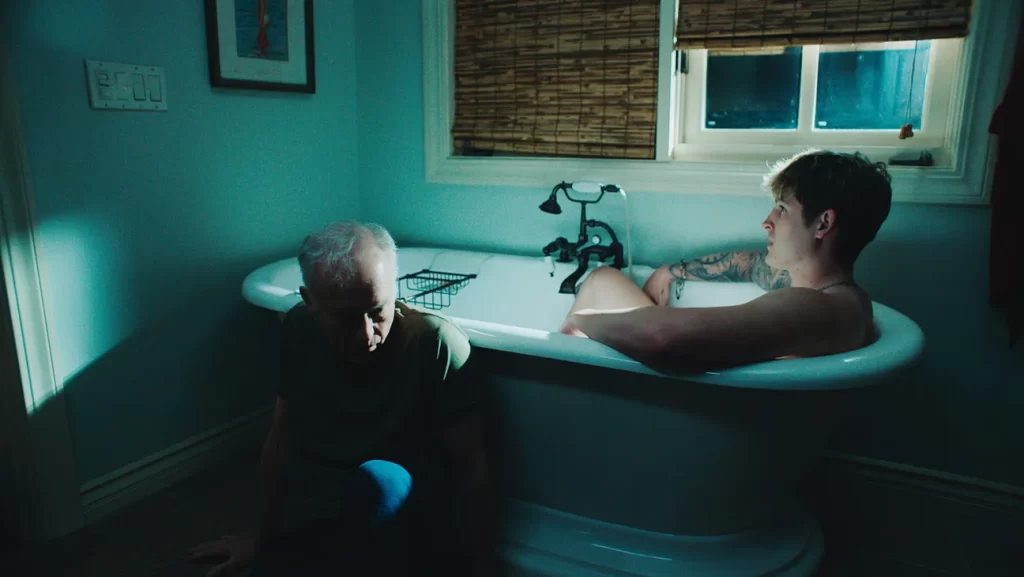
That’s the plot, and Blue Film is entirely a two-hander, following this long night through all of its highs and lows. Their stabs at physical play are abrupt and awkward; an attempt at a role play that calls upon their shared history is tentative, and quickly goes awry. But they keep talking, and the primary point of interest here is their push-pull, the turnabouts in their power dynamic, the walls Alex puts up when Hank gets too close, too personal, too intimate.
Tuttle’s screenplay falls, unfortunately, into some of the clichés of queer storytelling — the assumptions and explanations of who and why these two men are who they are. But Hank is completely matter-of-fact about his past and his flaws, and the picture mirrors that perspective, in a way that might put some viewers off. It’s a film that knows, as the best ones do, that there is no black and white, no easy bifurcation of good and bad, not really. Not that Hank thinks that; “It was wrong,” he says, and not only that, but “I’ve always known that it was wrong.” The simplicity with which Birney, a veteran character actor, delivers that line — hell all of his lines — is consistently impressive. This is an excellent performance, filled with regrets and shame and desire, and Moore, a comparative newcomer (all of his previous credits to date are short films and television roles) matches him beat for beat.
“I wonder if there’s purity in perversion,” Hank asks, and it’s a compelling question. Tuttle seems to think so, and that’s to his movie’s advantage. He genuinely builds to the sex, and to a point where it really means something; it’s narratively vital, and we’re watching these two characters (and not these two actors — or at least, not just these two actors) interacting in a telling, physical way, experiencing sexual contact as an act of giving, humanity, connection. Blue Film is a minor work, but an important contribution to the notion of real sex onscreen as a storytelling tool — a 60-year work-in-progress, done in fits and starts. It’s ultimately not about anatomy or even about sex; it’s about intimacy and kindness. And isn’t that what we’re all looking for?
“Blue Film” is out Friday in limited release.