Kimber Myers
In a video intro that played before my screening of Her Private Hell, director Nicolas Winding Refn impishly proclaims, “Polarization is success.” Whatever else can be said about the director of Neon Demon and Only God Forgives, the man knows his lane. Her Private Hell is unlikely to get a lot of three-star ratings on Letterboxd. (It’s currently sitting at a 2.3 average, which feels wildly generous to me.) I’m sure there will be people who love Her Private Hell and its sense of style, but I cannot imagine there will be too many of them whose names aren’t Nicolas Winding Refn. This is a highly personal, annoyingly silly film that is a gorgeous slog. I would rather stare at a single frame of Her Private Hell for 109 minutes than sit through the actual movie for its full runtime again.
Refn nods to a number of references in his first feature in over a decade. Her Private Hell is indebted to sources as varied as giallo films, fairy tales, Barbarella, Blade Runner, Brian DePalma, and the beautiful, bizarre oeuvre of David Lynch. Her Private Hell also shares a title with a little-seen1969 British sexploitation film, and there appear to be surface similarities between the two (at least as far as I can tell from its IMDb page since it doesn’t seem to be easy to find). But what Her Private Hell brings to the screen is the worst traits of all of its inspirations and of Refn. It’s a hollow exercise in style that is ostensibly focused on the relationships between fathers and daughters (as much as it is focused on anything), but its themes get lost amidst the brutal violence, nonsensical plots, neon lights, and pretty girls. (And I would feel bad calling these adults “girls,” but Refn clearly doesn’t see them as women or even people. If it’s any consolation, the men aren’t that well-developed either.)
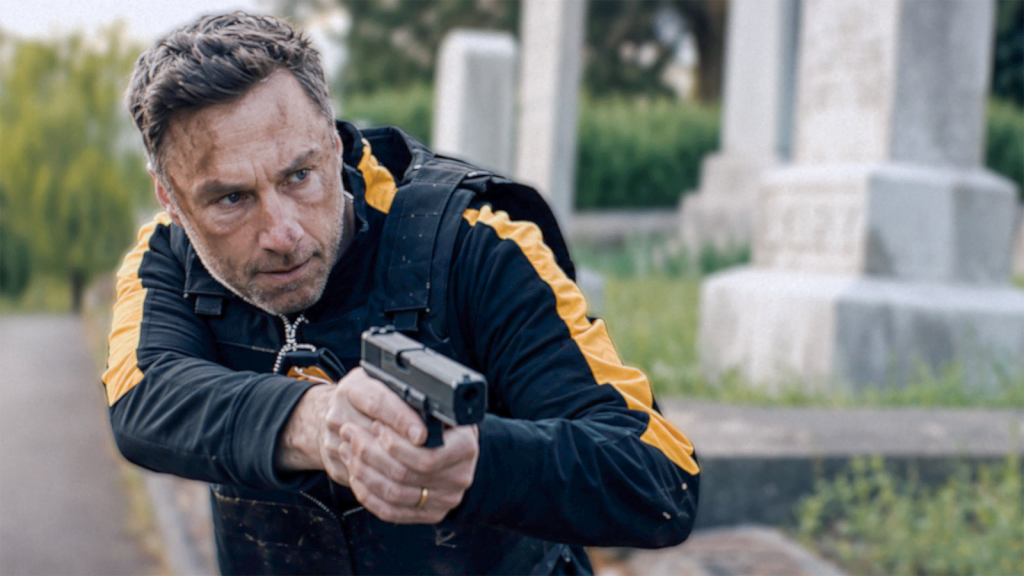
Trying to recount the plot of Her Private Hell feels like a fever dream. In a futuristic world, Elle (scream queen Sophie Thatcher) is the lead actress shooting a Barbarella-esque sci-fi film while she stays in a fancy hotel alongside her co-stars. One of them is Dominique (Havana Rose Liu), her former friend who has since married Sophie’s father, Johnny Thunder (Dougray Scott). Between the three of them, the vibes—and this movie is all vibes—are strange, but especially so between the two ex-friends. They alternately appear to want to kiss each other and kill each other.
Yet that’s not the only murder lurking in the air. A thick mist obscures the ground and lurks around the corners of buildings in a city that is reminiscent of Blade Runner’s Los Angeles. But the mist isn’t merely a meteorological phenomenon or yet another cinematic reference; it’s a harbinger of death. When the fog intrudes inside, it heralds the arrival of Leather Man, a mysterious killer who dispatches young women in grisly ways.

If Her Private Hell had only consisted of this plotline, it would have been relatively coherent, at least as far as Refn films go. However, the director and his co-writer Esti Giordani also attempt to weave in a story set in mid-20th century Tokyo, where American G.I. Private K (Charles Melton) fights his way through the city in the effort to rescue his daughter, who is stuck in hell. (Same, but alas, no one came to save me.) Refn’s script bounces between this blood-soaked neo-noir and the blood-soaked futuristic murder-y melodrama, and still manages to be boring as, well, hell.
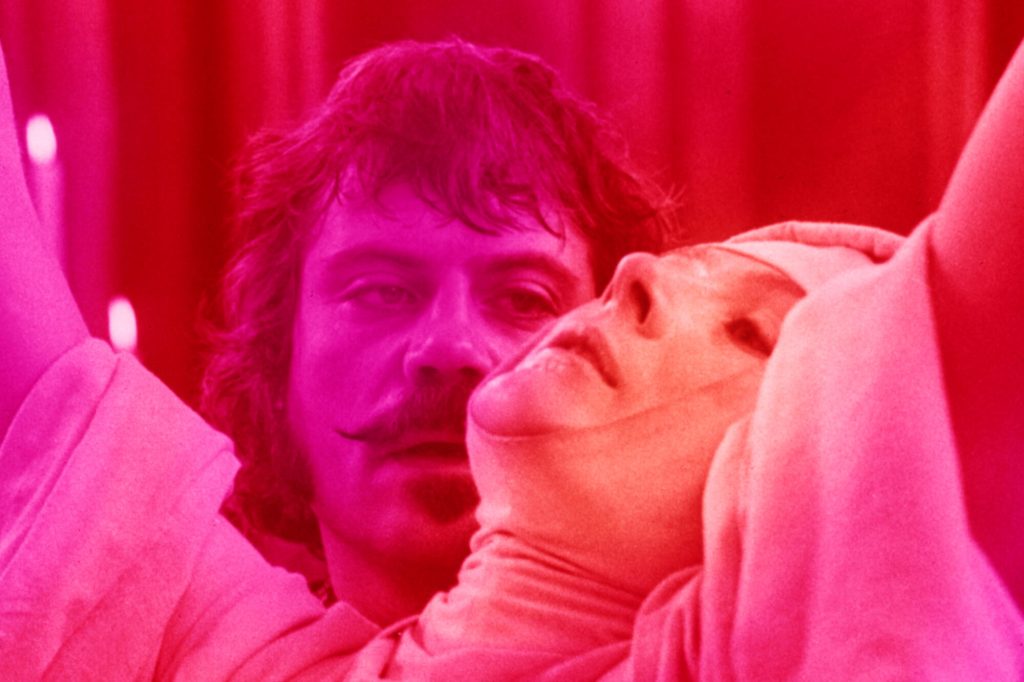
It’s wild that Her Private Hell is this dull with everything it’s trying to do. Refn is not aiming for realism with layer upon layer of artifice, but camp resides next to utter seriousness. It’s alternately bitchy and blasé, but it’s almost always an unpleasant mess. There are a few moments within a few scenes that work, but the rest feels so misconceived that it almost feels like Refn is trying to shoot the moon. The visuals—including the neon-lit cinematography by Magnus Nordenhof Jønck, sleek production design by Gitte Malling, and stunning costumes from Jane Whittaker—are perfection, but it all feels like a waste with the story surrounding them.
I have forever been trying to recapture the feeling of seeing Refn’s Drive for the first time, and sadly, the Danish director seems to have been trying to do the same as a filmmaker. He hasn’t yet reached those heights with subsequent films with either audiences or critics, and this isn’t likely to change that. Her Private Hell is a miserable viewing experience, but there’s always hope that the next one will be the film that marks a return to form of his earlier work. That’s why we keep watching and putting ourselves through hell.
D
“Her Private Hell” is in theaters Friday.