Jason Bailey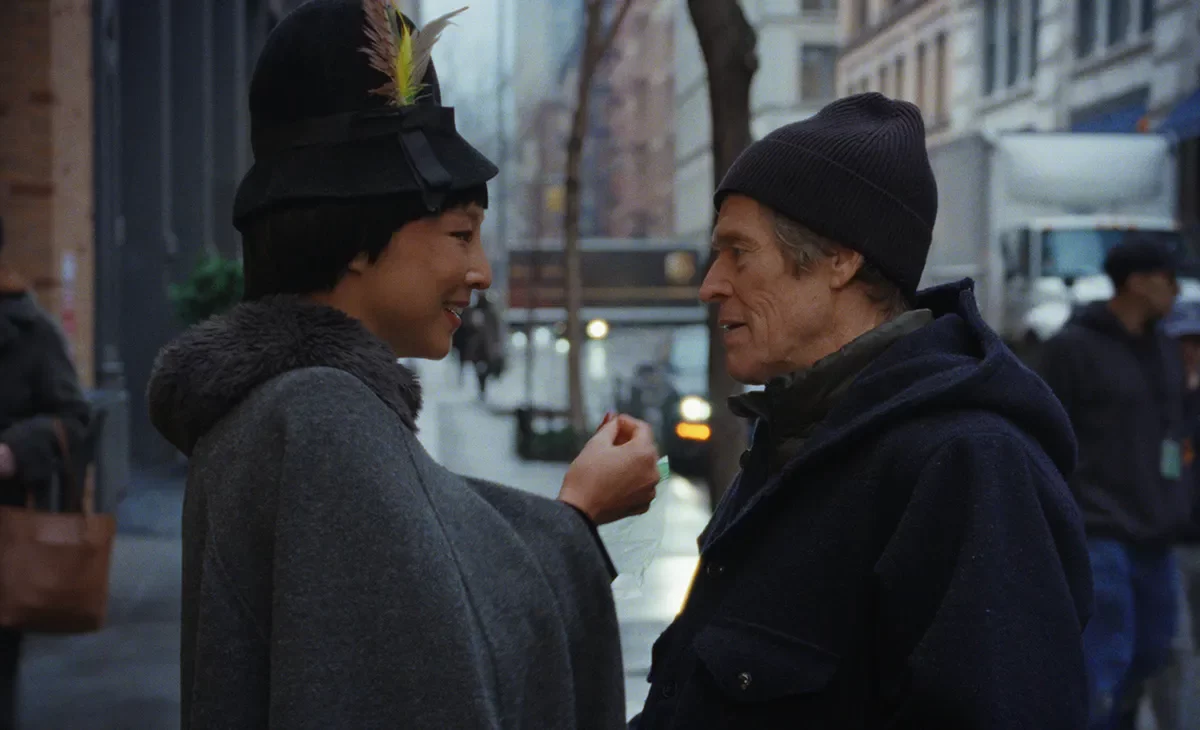
“I read Way Past Go,” says the young man waiting across the street from his apartment building. “You are the Ed Saxburger, right? The poet?” He is indeed the Ed Saxburger, the poet, but as he notes with a shrug, “that was a long time ago.” He hasn’t written in years. Now he works at the post office, his days among the poets and artists of the New York downtown scene a dim and fading memory. But the young man keeps pressing: “You wrote a masterpiece, whether people know it or not. Nothing can alter that, it’s forever.” That idea gets into his head, and under his skin. Isn’t it the secret hope of anyone who ever creates anything?
Saxburger, played with lived-in perfection by Willem Dafoe, is a working class guy, six years sober, who spends his time hanging out and playing pool with other blue collar dudes in a dive bar. And yet when the young man, a privileged poet named Meyers (Edmond Donovan), brings Saxburger into his “artistic community” of writers, poets, artists — something that does indeed exist in contemporary NYC, just not at the center of culture as they might have been in Saxburger’s youth — the older, forgotten poet feels welcomed and validated. At the end of their first scene together, director Kent Jones lingers on Saburger’s smile, just for a moment, and it’s a relatable moment. It’s nice to be included, to feel a part of something, to feel respected. And isn’t the warmth of their reception and interest a kind of semi-celebrity that many of us long for, even if we’d never admit it?
Perhaps that’s more personal an insight than one might ask for from a film critic, but Late Fame prompts that kind of thought and introspection. Nothing is simple about Samy Burch’s script, or Jones’s interpretation of it; take, for instance, “the group” (and that’s how they’re always referred to), which most films would frame either as pretentious clowns or with a wise-beyond-their-years purity. This film sees them with a nuanced eye; they’re admirable, and earnest, and ridiculous, all at once, and the dynamics that power them, the surface idealism and the messiness underneath, all ring true. And so does the tough, candid, emotional raw scene of him hanging out with his regular guys after, when he sees the sharp contrast between the young group’s idolatry and the ball-busting of his peers, and finds he prefers the former.
So much of this story is internal, about what’s going on in Saxburger’s heart and mind, and Dafoe can convey so much, so beautifully, by doing so little. What he’s doing here seems off-handed, easy even, but that’s deceptive; he can’t tip the character too far in any particular direction, and if he leans into aw-sucks modesty or inflating ego, the whole movie becomes false. He’s present, always exhilaratingly present, and when he finally gets up in front of these people and reads his work, when we finally have to believe who and what he is, he delivers.
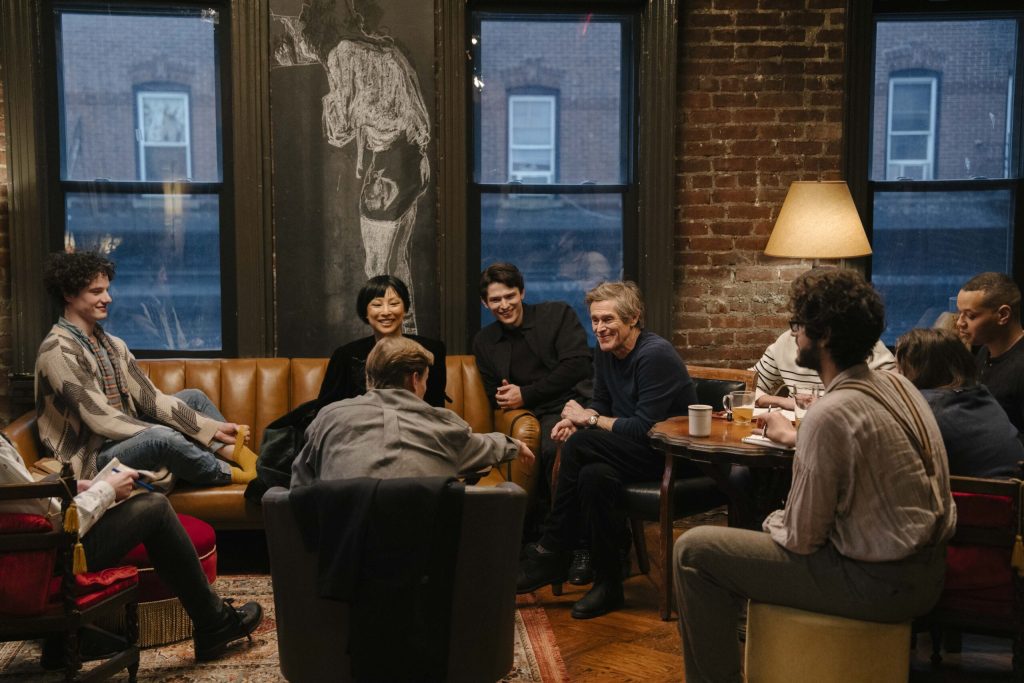
Donovan is also quite good as the de facto leader of “the group,” working up a delicate mixture of fanboy and narcissist; one of the knowing, perfect touches of Burch’s script is that Meyers got his MA at NYU’s Gallatin School. (If ya know, ya know.) Greta Lee co-stars as Gloria, the bigger-than-life actress and sole woman of the group, and viewers familiar with, and even enamored by, her previous work may well spend much of the picture asking if she is miscast, or just going unexpectedly big. The character, a kind of Norma Desmond-in-waiting, certainly lends herself to broad strokes (in her first scene, she makes a big show of ordering an absinthe, then leaves it on the table untouched, a perfect character touch). Those questions are, for my money, fully answered in her last two scenes — one in which we see how quickly the artifice reveals itself when she doesn’t have time to construct it, and another when she stumbles in for the big reading, half coherent, then gives a brilliant performance. Was the stumbling in part of it?
In addition to its showcase of fine performances, Late Fame is a sharp snapshot of contemporary NYC, with cinematographer Wyatt Garfield capturing some lovely and impressionistic images. The portraiture of the city sharply contrasts the archival footage that opens the picture, video images of the ‘80s NYC underground scene, scored by aggressive punk music. It’s an initially puzzling choice, until we realize that the ghosts of the city’s past are lingering on the edges of the frame. “Everyone was an artist, everyone was young, everyone was poor,” Saxburger explains, “until they weren’t.”
Burch’s script is based on a novel (by Arthur Schnitzler, the early 20th century author of the novella that inspired Eyes Wide Shut) but it has the modesty and attentiveness to detail of a good short story. Director Jones is a fascinating figure, a longtime film historian and critic who moved from cinema-centric documentaries to indie character studies with his 2018 triumph Diane. It took him a while to make his follow-up, but it was worth the wait.
A-
“Late Fame” is out Friday in New York and August 14 in Los Angeles, with additional cities to follow.