Julia Sirmons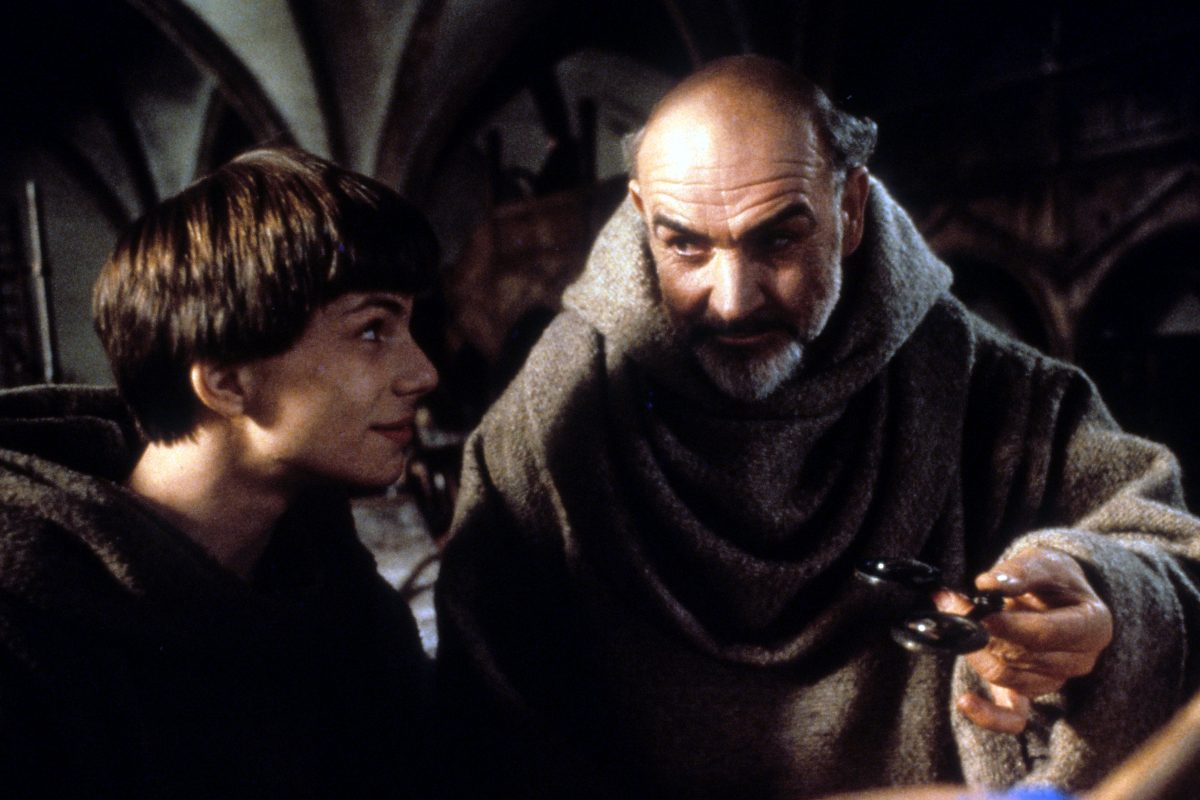
Commenting on Jean-Jacques Annaud’s film of his acclaimed international bestseller The Name of the Rose, Umberto Eco likened the adaptation process to peeling layers off a sandwich. The novel’s postmodern literary games had to go, as did its thorough representation of the philosophical and political debates of the 14th-century Catholic church. The cinematic version had to focus on the meat: a murder mystery and a searing battle between religious fanaticism and the belief in intellect and reason. But no Italian – hailing from the land that perfected the prosciutto and cheese panino – would insult something by likening it to a basic sandwich. And the film is indeed a simpler but satisfying bite; it’s fatty and tangy, and surprisingly complex.
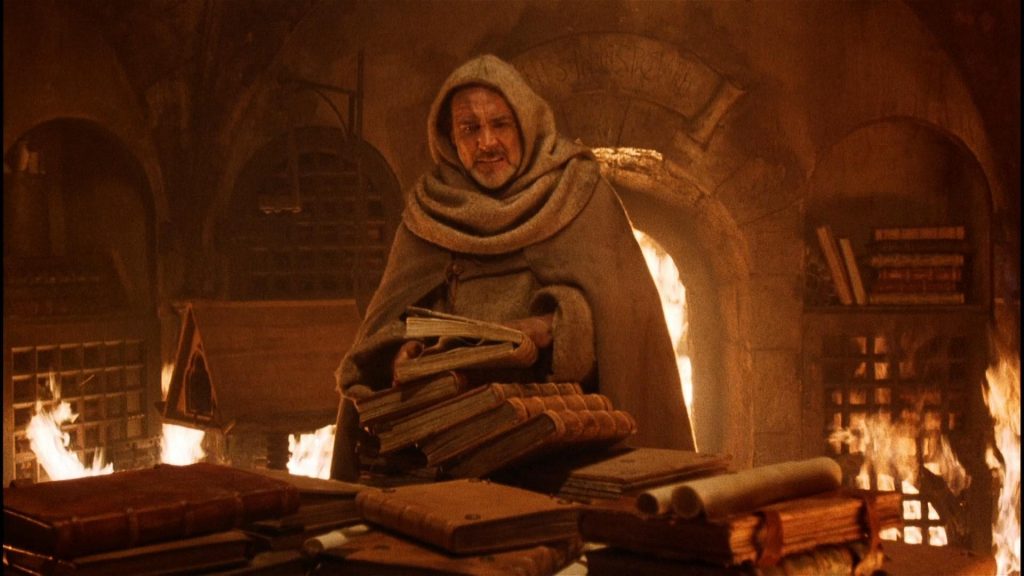
For all its erudition, Eco’s novel is fun because it belongs to a distinctly Italian tradition (which spans its greatest literature and its silliest porn) of fantasies of Creepy Catholicism. In these narratives, monks perform weird secret rituals, satisfy their rampant sex drives in the kinkiest ways possible, and indulge in rank hypocrisy. Annaud translates Eco’s version of this with great cinematic flair.The casting is spot-on: every monk you see on screen is grotesque in his own special way, via buggy eyes, fleshy, protuberant noses, and scraggly, greasy tufts of hair. (This is before you even get to Ron Perlman as a somewhat-reformed heretical hunchback – he mugs and grunts and spews with grubby aplomb.) The atmosphere is darkly mystical but also outlandish and fantastical. Famed production designer Dante Ferretti constructs an Italian abbey that is imposing, but also ethereal and surreal. In the abbey’s mysterious library, a dizzying network of rickety staircases traverses impossible spaces, making visible the thought patterns of the kind of inquisitive mind that the medieval Church wants to stifle.It’s a sinister and uncanny backdrop for some real pulpy pleasures – a combination that makes up an unusually complex whole.
Name of the Rose starts out as a medieval giallo, rendered not in bright yellow, but in the burnt umber of the stones of the abbey chapel and the earthenware jugs in the monks’ cells. It has a more staid framework, but the mixture of a whodunnit plot, potentially supernatural suspense, (homo)eroticism, and spectacular violence (one of the murder victims is found legs-up in a vat of pig’s blood) gives you the kind of fun and stylish thrills of that fantasy-fueled Italian tradition. The long fingernails and unsettling boy soprano voice of a maybe-villainous assistant librarian, the fetishistic close-ups of hands fingering bejeweled crucifixes, and the atmospheric dread you feel after too many shots of men lurking ominously in their cloaks all set a thrillingly creepy mood.
The plot hinges on a philosophical debate about comedy. The intellectual monks debate whether humor is always dangerously sacrilegious, or whether it can have moral utility. Wittingly or unwittingly, Annaud answers the question with some surprisingly goofy overtones. Many of these come from Sean Connery’s star turn as the monastic sleuth.He’s not the most intuitive choice to play a senior citizen virgin who only has romantic feelings for long-dead philosophers.You’re watching to see him out of his element – wearing a touch of smudgy eyeliner and giving the abbot a “brotherly kiss” on the lips. But the fact that he’s a fish out of water works; his wryness and jolly virility make him stand out as a modern man ahead of his time. His character’s name is William of Baskerville, a reference to the hyperobservant, unfailingly logical Sherlock Holmes.When William, borrowing Holmes’s catchphrase, describes one of his discoveries as “elementary,” Connery delivers the line in the same winking way he famously intoned, “Bond. James Bond.”
Connery plays very different notes in the second half, when the murder mystery is overtaken by an equally dramatic but more morally horrifying terror of the Catholic Inquisition and literal witch hunts. A few murders are all in good fun, but torture and the burning of innocents are another thing altogether. The full spectacle of the Church and its grisly rituals could be easily played as camp, but when thrashing bodies are menaced with hot pokers, it hits as hard as it should. As the Grand Inquisitor, F. Murray Abraham never tips into mustache-twirling villain territory – his fiery gaze and constantly flared nostrils are the signs of the true, terrifying fanatic.
Connery’s William, a bruised and battered veteran of the Church’s war against “heresy,” is resigned to this nonsense and hates himself for it. The focus shifts to William’s young novice Adso, played by a then-unknown Christian Slater. Impossibly young, his face has none of the angularity it would later acquire. Delicately arched eyebrows are the only sharp part of him; they frame darting eyes that are taking in far too much as he tries to act as his master’s moral compass before time runs out.
Of course, the prospect of burning some accused witches at the stake should be at least a little fun, and a scorching climax resolves both parts of the plot with a good deal of glee alongside the pathos. It’s a fitting conclusion to a film that proves simplifying the recipe doesn’t necessarily mean sacrificing complexity.
“The Name of the Rose” is streaming on Amazon Prime, Kanopy, Hoopla, and several ad-supported streamers.