Craig J. Clark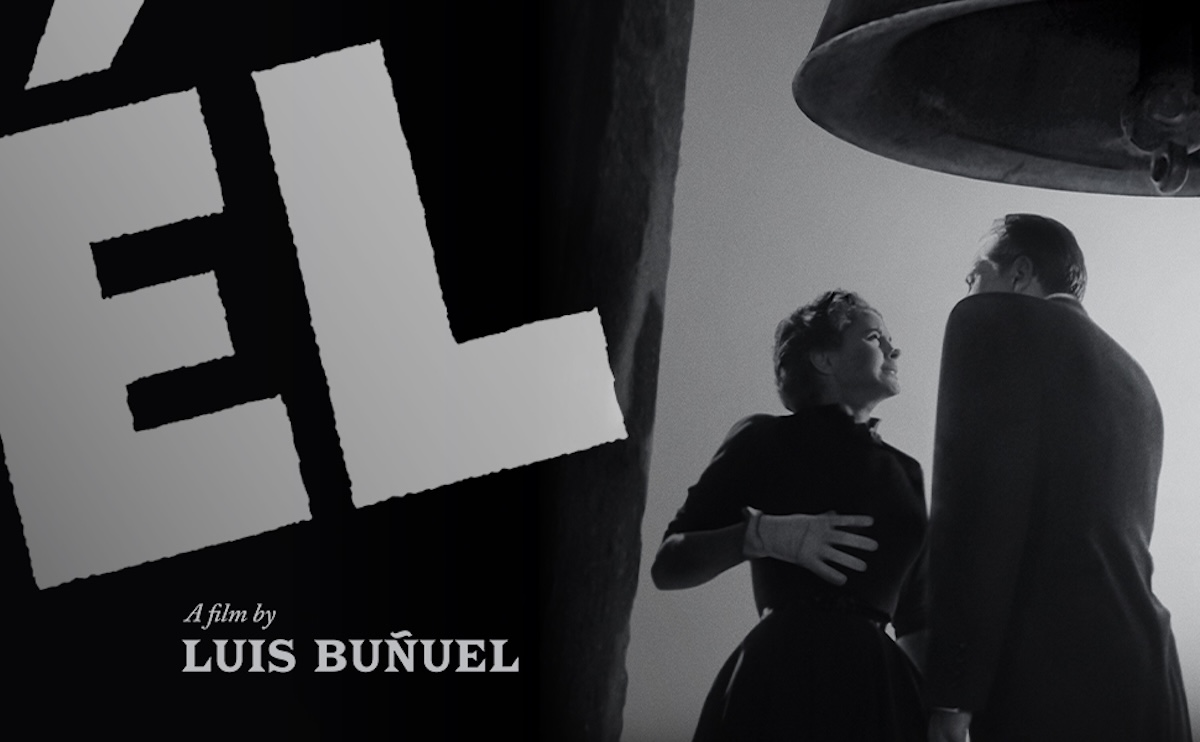
Mexican cinema of the late ’50s was awash in all manner of monsters. Not just your standard vampires, werewolves, and witches, but also a headless horseman, invisible man, and Aztec Mummy. (The latter headlined a trilogy and wound up on Mystery Science Theater 3000 when it tangled with a robot.) One that beat them all to the punch, though, was the decidedly human monster at the center of Luis Buñuel’s 1953 film Él, now streaming on the Criterion Channel in its full Criterion edition.
Following his return from creative exile, Buñuel worked at a steady pace within the Mexican film industry, turning out melodramas and potboilers for producers Óscar Dancigers and Sergio Kogan. Whenever he could, Buñuel injected surreal touches into the scenarios, but he was far from adopting a “one for them, one for me” policy. One in the latter camp was Él, made for Dancigers, which attracted controversy upon its Cannes premiere when jury president Jean Cocteau called it “a regrettable, commercial film.” In a letter to a friend, Buñuel wrote that “it’s not, as Cocteau thought, a film I made ‘to make money’. Failure or not, and in spite of some trite sequences, it’s a film I had great interest in making.”
That interest is evident in the opening sequence, which takes place during a church service where the faithful are gathered to witness the ritualistic washing of the altar boys’ feet, which the priest concludes by kissing them. Also taking part are civic leaders, including Francisco (Arturo de Córdova), a middle-aged businessman acting as water bearer, whose gaze strays to the feet of a woman in the congregation. This is Gloria (Delia Garcés), and she is immediately the object of his obsession for reasons neither can articulate.
Gloria protests that she’s engaged, but that’s no obstacle to Francisco, who engineers an invitation for Gloria and her fiancé Raúl (Luis Beristáin, later one of the trapped guests in The Exterminating Angel) to a dinner where he lays out his philosophy. “I hold a highly singular view of love,” he says, adding, “Love must spring up spontaneously when two people meet and know that nothing can part them.” He directs the last to a visibly uncomfortable Gloria, who always senses when his eyes are on her. In spite of her deflections, Francisco is not the sort who takes “no” for an answer, not when he’s been conditioned his whole life to only accept “yes.”
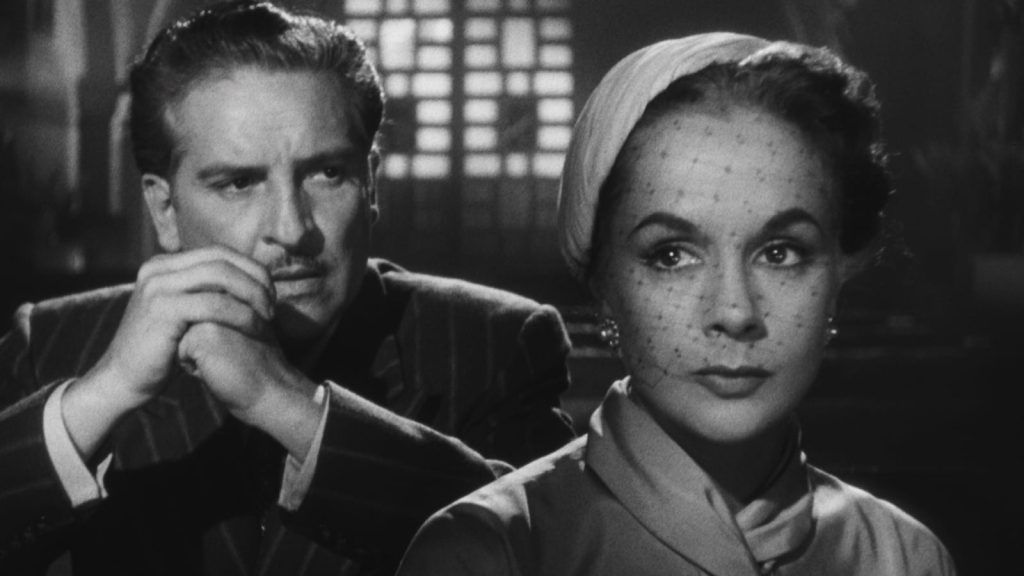
In his way, Francisco is the embodiment of the Surrealist concept of amour fou, and his ability to mask his mania with his social standing demonstrates how society makes allowances for those in its upper ranks. Even when he gets what he wants, though – Gloria breaks her engagement to Raúl and marries him – Francisco can’t enjoy his victory. Their honeymoon period is as brief as can be, with his jealousy rearing its head whenever Gloria so much as shares a friendly word with another man.
While she’s expected to be above reproach – he makes a point of praising her “aura of kindness and deference” – he can act abominably and expect the world to take his side. (His friends all make a big deal about how “normal and level-headed” he is, calling him “a perfect gentleman.”) The capper comes when he specifically asks her to be nice to his new lawyer (the latest to take on a hopeless land dispute) and is enraged when she is. (Francisco’s belief that he has a legal leg to stand on is another one of the delusions Buñuel delights in poking holes in.)
Throughout the film, Buñuel and co-writer Luis Alcoriza (a frequent collaborator during this period) deftly illustrate not only the depth of Francisco’s mental imbalance, but also Gloria’s growing alarm when confronted by his unpredictable behavior. (She also learns she can’t count on any outside help, either.) And Gabriel Figueroa’s rich cinematography provides the proper shading to illuminate the rift between them. By the time Francisco contemplates performing an unspeakable act, made all the more horrifying thanks to how Buñuel and Alcoriza leave the audience to fill in the blanks, it’s patently clear their marriage is beyond saving, and that goes double for his sanity. Working within his budgetary limitations, Buñuel rises to the occasion.
While Él left Cannes empty-handed and did poorly at home, it was picked up for distribution in the US, where it was released under the title This Strange Passion. Buñuel also continued making films for Óscar Dancigers, including adaptations of Wuthering Heights and Robinson Crusoe, the latter earning an Academy Award nomination for Dan O’Herlihy, but he was already looking beyond Mexico. He made good films there – and some (Él included) that can be considered great – but he yearned to work in Europe, where he believed he would have access to better actors and technicians. Before long, he got his wish.
“Él” is streaming on the Criterion Channel.