Sara Batkie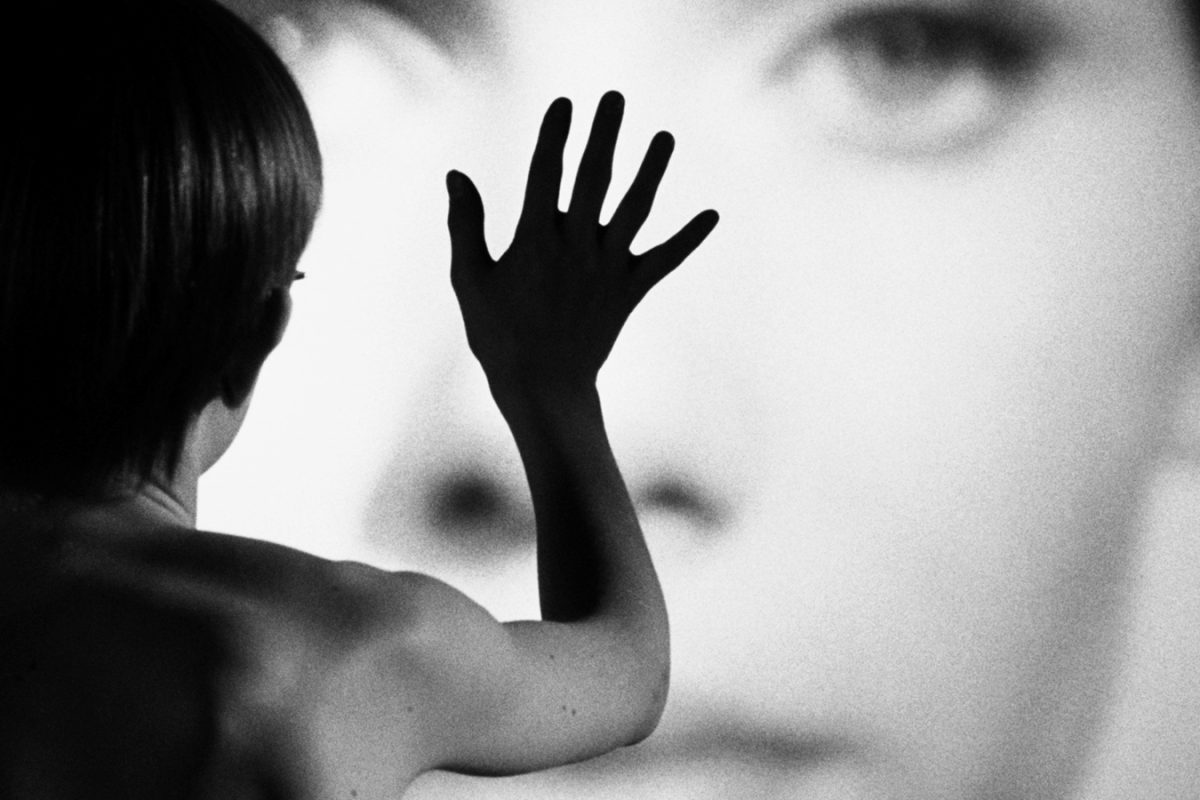
It’s possible never to have seen Ingmar Bergman’s Persona and still know its imagery intimately. It has been imitated and ripped off by countless directors since its initial Swedish release in August 1966 (its promotional run began in October and it opened in the U.S. the following March). Yet at a time when concepts like dissociation and parasocial relationships have entered the mainstream, it’s bracing to revisit the original cinematic rendering of such psychological states sixty years on. A singularly slippery and uncanny film in a career with no shortage of work that earns such descriptors, Persona is perhaps the most admired of Bergman’s prolific output that’s also his least definitively interpretable.
Bergman once wrote that, “Our work in films begins with the human face,” and he has two of the greatest in cinematic history at his disposal here. Frequent collaborators Liv Ullmann and Bibi Andersson are the stars and, for the most part, the only real presences onscreen. Such a setup would eventually be called a two-hander, but Bergman’s attention is fixed on more expressive parts of the body. At times the close-ups here are so penetrating and linger so long that it feels as if the director is attempting to crawl inside his actresses’ skins.
The inherent boundaries of the representational image is one of Bergman’s main thematic interests, as evidenced by the jarring opening sequence. We begin literally inside of a projector as the arc lamp ignites and a reel is fed through. A series of images briefly flash across the screen: some are entertaining, like a clown cartoon; others are more disturbing, like an erect penis or a closeup of a palm as a nail is hammered into it. These are not presented uniformly, and Bergman offers no clear linkage between them for the viewer. But just by introducing them, he’s setting us up to access our subconscious, not unlike how a Freudian psychologist might encourage a patient to tap into repressed memories.
Eventually, Bergman does settle on a figure: a young boy who’s roused by a ringing telephone. His attention is drawn by something out of frame and, in the first of many striking instances of the fourth wall breaking, he presses a hand to the surface of the lens. A subsequent cut reveals him to be caressing a screen that is filled with a woman’s face, which seems to morph almost imperceptibly between Alma (Andersson) and Elisabet (Ullmann). Bergman has introduced another potential key for understanding his film: a duality that can be embodied by two people, or represent “contradictory aspects of a single person,” as described by critic John Simon.
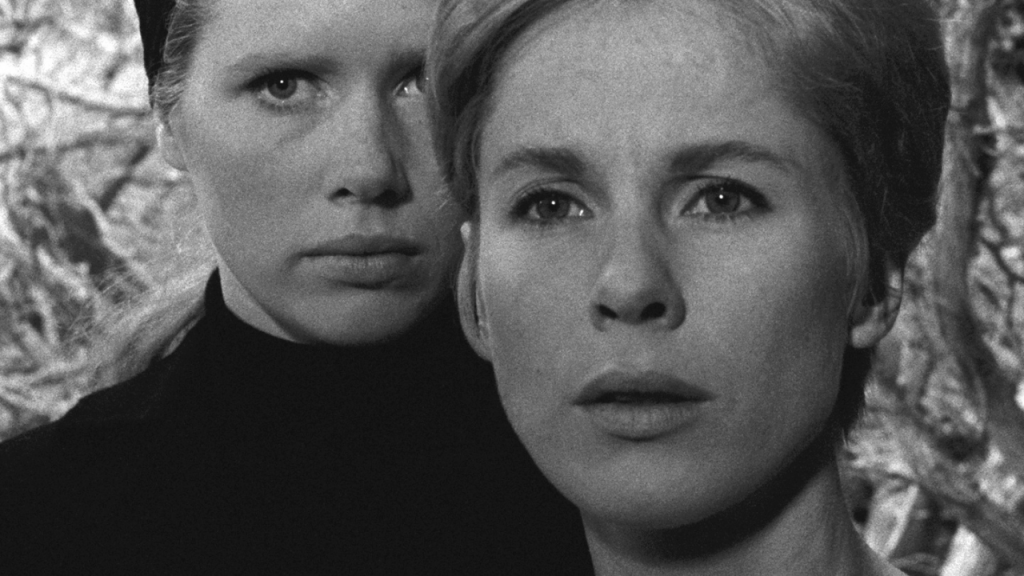
It would be difficult to provide a coherent plot description for Persona, but certain through lines can be parsed out. Alma is a nurse who has been assigned to care for the actress Elisabet Vogler, who went inexplicably mute after a performance of Elektra. At her doctor’s behest, Elisabet and Alma move to a seaside cottage, where their intense proximity to one another leads to erotic confessions from the garrulous Alma and cryptic silence from the enigmatic Elisabet. The staging of the two women within the frame is pointedly constructed; their faces eclipse and orbit each other like celestial bodies on the same trajectory. Whether they will merge together or obliterate one another is the source of much of Persona’s tension. Their encounters often play like exercises. When a letter written by Elisabet to her doctor reveals that she considers Alma an object of “study,” their relationship ruptures, along with the film itself, though their personalities only become more intertwined.
Many critics have identified Persona as “a kind of modernist horror movie,” in the words of editor Lloyd Michaels. The stark cinematography by Sven Nykvist and discordant musical stings certainly invite that reading. The combining of Alma and Elisabet’s faces recalls the good and evil dichotomy explored by Robert Lewis Stevenson in Dr. Jekyll and Mr. Hyde. There is also a vampiric aspect to the connection between the women, even before Elisabet literally sucks blood from Alma’s wrist. And though “art monster” wouldn’t become part of the cultural lexicon for several decades, the manner in which Alma takes Elisabet to task for cannibalizing her life for her own gain has resonance with the concept.
Bergman, of course, never admitted to any one explanation, often stating that he wanted the film to be “felt rather than understood.” He was inspired to write the script after encountering Andersson and Ullman on the street together and noting their resemblance, completing it in nine weeks while recovering from pneumonia at the Sophiahemmet hospital. The majority of principal photography took place on Fårö Island, where Bergman had a property and many of his films were shot.
The film was censored in its U.S. and U.K. release and not considered a commercial success. But this didn’t bother Bergman much; he later stated that “Persona saved my life.” Critics, at least, agreed that it was monumental and it has ranked highly on every Sight & Sound poll since its release. Its impact on other directors was apparent as early as Robert Altman’s Images a mere six years later. That it remains a work of such impassioned debate and homage six decades on demonstrates its uniquely cinematic essence, where meaning is inseparable from medium. Fittingly, it leaves us where it begins: the boy caresses the screen, the reel spins out, and the arc light dims, casting us adrift in a darkness only the next picture show can illuminate.
“Persona” is streaming on the Criterion Channel and HBO Max.