Jason Bailey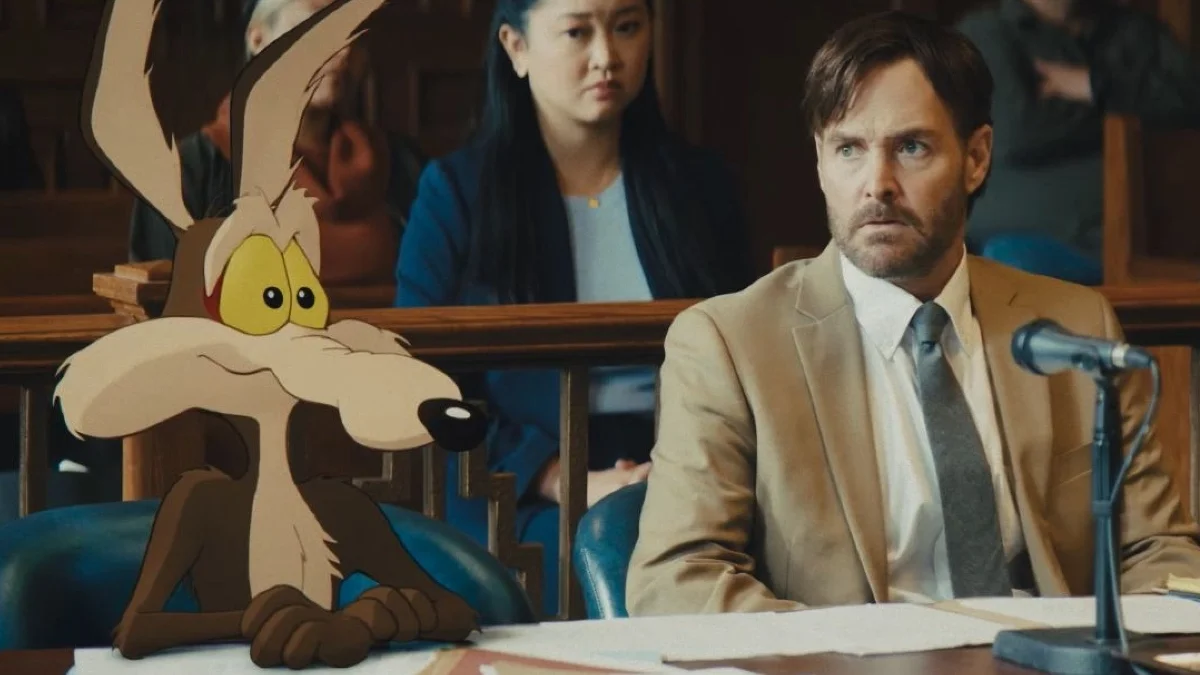
There is a real danger, in criticism of any kind, of artistic confirmation bias, of wanting a film or book or sculpture to be great, and convincing yourself that it is, primarily out of philosophical allegiance. It’s a case of intertwining two discrete ideas — that something is of artistic merit, and that something is of cultural import — when one often has nothing to do with the other. (I’m not throwing stones; I’ve done it myself.) So I’m relieved to report that Coyote vs. Acme, the Looney Tunes-based live-action/animation hybrid that has been a regular fixture of the trades since Warner Bros Discovery inexplicably attempted to delete it from existence as a tax write-off, is not only a complete delight, but is unexpectedly enhanced as a motion picture by the shenanigans surrounding it.
The story, inspired by a clever 1990 New Yorker piece by Ian Frasier, begins in 1992, as we witness the disappearance of one “Dr. Lorre” (the Looney Tunes Peter Lorre-inspired cartoon) from the Acme labs, as he makes enigmatic proclamations like “I know too much” and “Someday… the truth will be known!” Thirty years later, we’re in the desert outside Albuquerque, wherein Wile E. Coyote and his perpetual target the Road Runner are introduced with a hybrid sequence that’s worthy of comparison to the original shorts. Director Dave Green told me he watched all of those cartoons and put them into a spreadsheet, cataloging the gags and their construction, and he shows his work, smoothly recreating the impeccable slapstick logic and clever Rube Goldberg-style domino effects that makes them so memorable.
But then he goes a step further, following Wile E. back to his cave, which is like a museum of failure — the floors are cluttered with defective products, and his filing cabinets are stuffed with abortive blueprints. “I feel bad for him!” my nine-year-old daughter announced, unprompted, an early indication of one of the small miracles of the movie: pulling pathos out of what are, essentially, animated Three Stooges shorts.
Reveling in his frustration, Wile E. catches a TV commercial for the law firm of Avery, Jones, and Maltese, who practice cartoon law with cartoon products (a quick glance at the firm’s bookshelves reveal a row of volumes on “Anvil Law”). The matter-of-fact integration of the cartoon and “real” worlds is where the picture displays its most obvious connection to Who Framed Roger Rabbit — that, and the excellent lead performance of Will Forte as lead attorney Kevin Avery, who is an exquisite foil. His reading of “Objection?,” after his opposing lawyer uses a button to eject a witness from the stand, should be taught in acting schools.
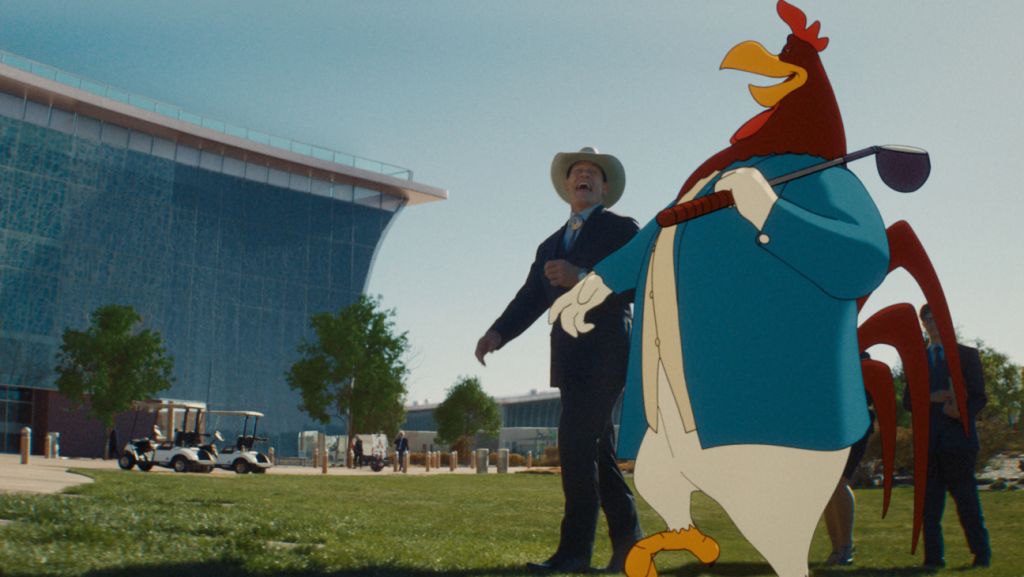
Said lawyer is played by John Cena, which is genuinely bang-on casting, since he’s essentially a live-action cartoon — big frowny face, ridiculous proportions, fully committed line readings (“Cartoons are supposed to be funny,” he pouts). As Avery’s niece and legal protégé, Lana Condor is a wonderful force of positive energy, making the cliché of the optimistic, idealistic intern into something fresh (and necessary). Martha Kelly and John Early make the most of their small but noteworthy turns, and while Luis Guzman doesn’t get much to do, he has the invaluable “movie judge” skill of fuming quietly.
The big names, however, are the Looney Tunes characters. Wile E. is the focus, though Bugs Bunny gets a movie star entrance and a role as the story’s Deep Throat (“I have information that could stop Acme for good”) that turns it into a conspiracy thriller. There are also brief but welcome appearances by Daffy, Porky, Tweety, Taz, and “Senator Fudd,” as well as plenty of little winks for diehards (an offhand reference to a wrong turn outside of Albuquerque, the appearance of a “predator spray” for Pepe Le Pew, and of course the law firm itself, which is named after beloved WB animation figures Chuck Jones, Tex Avery, and Michael Maltese). A few loose strands of Samy Burch’s script don’t quite go anywhere, but her one-liners and set pieces have real punch, underscored by Green’s active, energetic camerawork (particularly during an inspired chase scene with a series of malfunctioning Acme products). It’s all high-spirited and fast-moving, and if all the jokes don’t land, there’s always more to choose from, both in the foreground bits and the background gags and delayed payoffs.
But some of the biggest laughs in Coyote vs. Acme are almost inadvertent, the result of its years-long battle with Warner Bros. Discovery, which financed and produced the film under one regime only to attempt to disappear it under the next. By the time of the climactic Congressional hearing into the malfeasance of Acme (a notion paralleled by Congressman Joaquin Castro’s call for investigation into the malfeasance of WBD), it’s hard not to draw parallels between the company the movie is about and the company that made the movie.
And the filmmakers welcome them, from the WB logo at the beginning, which designates the studio as “a wholly owned subsidiary of the Acme Corporation.” That’s a nice touch, but no one could have foreseen the degree to which Acme head Foghorn Leghorn echoes WBD CEO David Zaslav, particularly when he spouts barely-satirical corporate bromides like “We’re a company of family values that values our family… of companies” or “When a company is this successful, there’s always somebody looking to tear it down” or, simply, “Well, son, business is complex,” which is basically the substance of the studio’s statement when they pulled the rug on the picture.
The Looney Tunes have always functioned as cultural and social satire, and those elements were present in Coyote vs. Acme even before the whole offloading mishegoss. In its deft script, Acme is presented as a monopoly, with all the negative connotations therein; as Forte’s Avery rages, “These companies think they can do anything they want and get away with it!” It’s a company that churns out products that don’t actually work, and yet nobody does anything about it, or takes their business elsewhere, because there are no other options. In other words, it’s a movie about enshittification, and the despair it engenders. “We won’t beat Acme!” Avery announces. “Nobody ever has, and nobody ever will!” But just this once, someone did — and the fact that they did so with such a charming, entertaining product is just icing on the cake. Or, more appropriately, the birdseed atop the metal pellets.
A-
“Coyote vs. Acme” is in theaters this weekend.