Jason Bailey
There’s a scene around the midpoint of Chris Rock’s new film Misty Green in which the writer/director/actor, playing a filmmaker, chastises his title character. A night out has gone sideways, in scary and dangerous ways, and he lets her have it, unloading on her about her poor choices and self-destructive impulses. And maybe it wouldn’t feel like this had he not cast himself in the role, but in retrospect, the entire film feels like a two-hour version of that scene. Rock has never exactly been a female-forward figure; his early stand-up specials, brilliant as they could be, were often tinged by a strain of misogyny, a sense of perhaps baked-in cynicism about women and what motivates them, and his films have frequently suffered from similar inclinations. Going in, I wondered if he was making a character study about a woman as an attempt to rectify or at least address those shortcomings. The fact that I’m still not sure — that you can read the picture as that or as him doubling down — speaks to the blurriness at its center.
Rock is a New Yorker, and most of his earlier films were set there; this one feels like his L.A. movie, starting with an opening credit sequence (with an especially lounge-y cover of “If My Friends Could See Me Now” accompanying still images of the city in all its complexities, from red carpets to homeless encampments) that feels like a riff on the beginning of Manhattan, with stills instead of moving images. At the center of his L.A. is Misty (Rosalind Eleazar), whose background is efficiently summarized by her first scene, in which the wife (Amy Landecker) of her dead boyfriend shows up at the apartment he was paying for, to kick her out. Then she spots Misty’s Emmy on a shelf. “Oh my god, I remember you!” she exclaims, her entire vibe shifting.
But Misty’s career never quite took off, and it’s starting to look like that ship has sailed. (Other actors and observers keep telling her how much their parents liked the show she was on, a quick and concise way to summarize where she’s at, in her life and career.) The wife gives her seven days to find a new place to live, kicking off a rolling snowball of problems big and small, some self-inflicted, some external, some just rotten luck. Misty is a great actor and a great singer (ditto Eleazar); she’s also prickly and confrontational, and she really likes cocaine. So she suffers from a believable — and probably common — strain of self-destructiveness; this is not someone bottoming out in a public toilet or something similarly over-the-top, just a gradual accumulation of small but impactful poor choices.

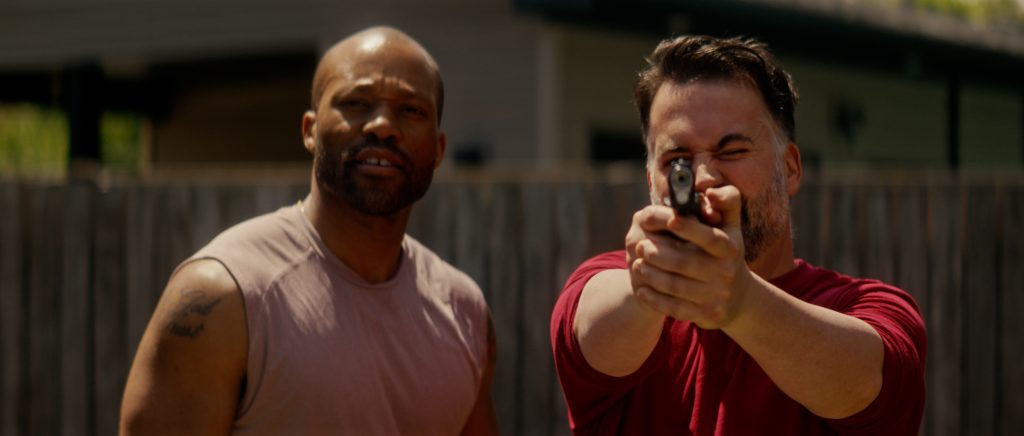
Yet you never really get a sense of how Rock wants us to feel about her, or (and this is key) if that ambiguity is on purpose. One gets a sense that he was at least subconsciously aware of that hole in the center of the movie, because he tries to fill it with all sorts of side plots and shakily connected secondary characters. Many of them are decent diversions; Adam Driver gets to play some intriguing new notes as a very specific breed of oily sleazebag, Anna Kendrick has a good time playing Misty’s messy bestie, and while Topher Grace isn’t doing anything new as her morally flexible agent, he sure does do it well.
But then there’s the business of Misty’s bipolar brother, who is brought to life by Daniel Kaluyaa. He supplies moments of power (make no mistake, this Oscar winner is acting his ass off), and it’s hard to argue with the good intentions here (since Rock literally states them with a bit of on-screen text that feels, in the moment, like it must be a gag). But good god, it feels dropped in from an entirely different movie.
And maybe that’s the trouble; at some point, Rock needed to decide what the hell he was making, and make it. There are long stretches where it does indeed work as an inside showbiz exposé. Rock knows this milieu, using real names and the particulars of the real movie business, he’s good at making the microaggressions of the business especially vivid (the first big audition scene is brutal), and he mines material out of the less discussed details of the industry, like the “bullshit physical” or the “first rule of show biz”: “Work the wives!”
But by the time his lead is contemplating blowing off a leading role in a major production to make a quick buck partying with a prince in Dubai, we have to ask a troubling question: Does the world see Misty Green as a woman for sale — or does the movie? And unfortunately, Rock doesn’t seem to have answered the question himself. In fact, based on what’s onscreen, he may not have even thought to ask it.
C-
“Misty Green” is in theaters Friday.