Jason Bailey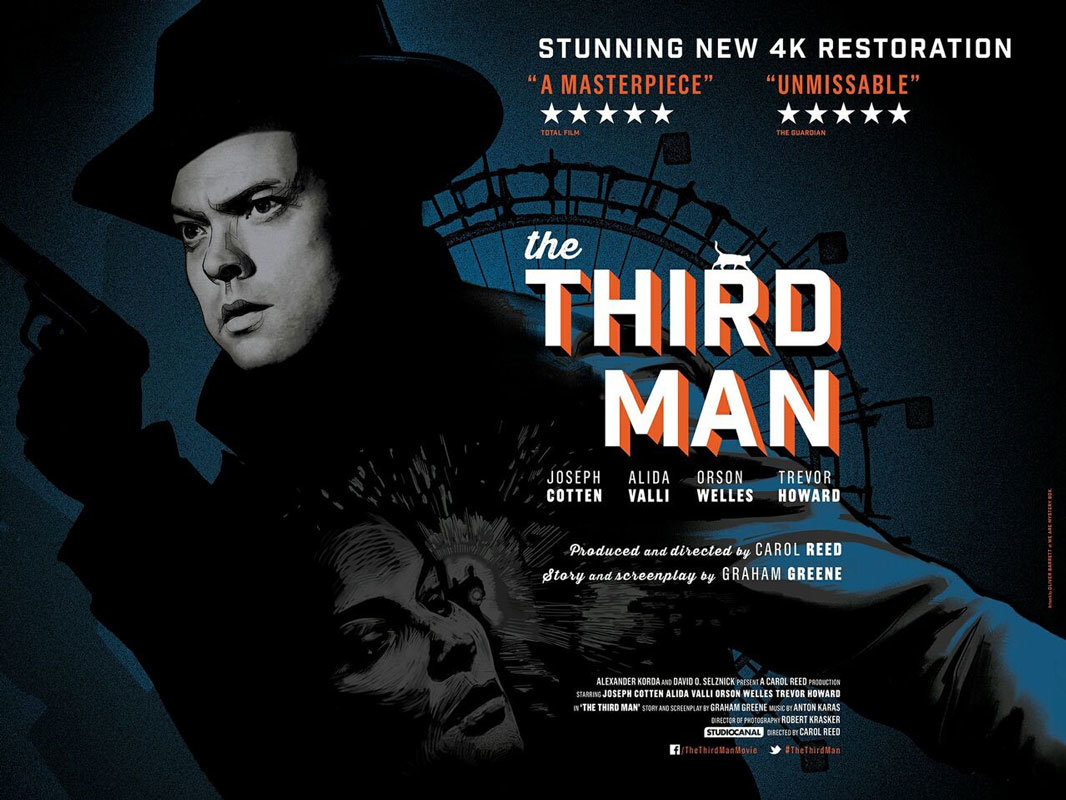
Here’s the thing about The Third Man: no matter how little you remember Orson Welles being in it, he’s in it even less. His entrance is such absolute perfection, both in its execution and build — he’s the sole subject, the only topic of conversation, for the better part of an hour — that the picture has become a reference point for a well-prepared entrance, the title you drop to convey that a key character doesn’t come in until late in a narrative, and with plenty of fanfare. But even in the likely event that you recall the tardiness of his appearance, you may well have forgotten that after that wordless entrance, he has a single dialogue scene, and then the chase, and then the movie’s over. But when you think of The Third Man, you think of Orson Welles. That’s a role designed for an actor to make an impression, and Welles never had trouble doing that.
Luckily, the movie around him is a masterpiece, so it doesn’t matter much that he inhabits it so fleetingly. The setting is Vienna, post-WWII, “the era of the black market.” Our hero is the absurdly monikered Holly Martins (Joseph Cotten), who arrives in the city “happy as a lark and without a cent,” according to an opening narrator who is never identified and never heard from again. Martins has been called to Vienna by his longtime pal Harry Lime, so yes, as a matter-of-fact chap puts it, it is indeed “awkward” when Martins discovers his friend was stuck by a car and killed on the very day of his arrival.
“Best friend I ever had,” he notes, to which the Field Security Section man he’s talking to, Major Calloway (Trevor Howard), replies, “Sounds like a cheap novelette.” Coincidentally enough, Holly Martins writes cheap novelettes, so he starts poking around, using little but the offhand explanation, “I was a friend of Harry Lime.” The casual nature of the mystery is part of what makes it intriguing; Holly is not some sleuth, and has not been hired to investigate. He just can’t walk away. (You get the feeling it’s a question of honor.)
So he starts knocking on doors and rattling cages, and encounters enough genuinely terrible liars that the whole thing starts to smell. The Third Man’s director, the great Carol Reed, does something clever as Holly goes deeper and the facts start colliding with each other: he starts tilting the camera, slightly at first, then more, the Dutch angles reflecting the unsteadiness of the reality around him, the tornado of half-truths that has whirled up around his friend. There’s a girl, of course, as there always is, who tells him, “You shouldn’t get mixed up in this.” It’s the understatement of the year.
The fate of Lime — which I’m assuming we can discuss here, unless we’re really doing spoiler alerts for 77-year-old movies — is such an excellent rug-pull that perhaps it would take a magician like Welles to pull off. It’s a question of misdirection; the first act distracts us so well with one question (murder or accident?) that we don’t ask the more important one (dead or alive?). The unaware viewer might even expect the mysterious figure who appears around the hour mark, far away and from an oblique angle, to be the title character, which makes it even more delicious when the camera finally pushes in as the light crosses his face, and there he is, Welles and his impish little smile, a perfect screen moment. And then he’s gone again.
When Holly and Harry — and thus Welles and Cotten — are finally face-to-face, they immediately fall into the rhythms of the longtime friends they’re playing. This didn’t require much acting; Cotten had been a member of Welles’s Mercury Theater company, and by the time they shot The Third Man, they’d been acting together for a decade and a half. They step on each other’s cues, their dialogue overlaps, they color their lines with knowing glances and inside jokes. Welles mouths some of the most-quoted dialogue in all of cinema, the cuckoo clock monologue, but it never feels like a Big Speech, partly because it presents itself so organically and conversationally, and partly because Welles punctures it so beautifully with his throwaway “So long, Holly” at the end.
Welles is given such a juicy prime rib of a role that it’s easy to take Cotten for granted, and that just means he does his job well; he’s a sturdy anchor and a compelling audience surrogate, and altogether unconcerned with coming off as anything close to heroic. He’s able to pay for his lodging by agreeing to talk to a group of book lovers about writing, and one of the funniest touches in Graham Greene’s script (and there are many of them) is how when he finally fulfills that obligation, he basically clears the room with his stammering responses. This is the picture’s second-clearest connection to film noir: the protagonist is a bit of a sap, borderline incompetent, certainly clueless.
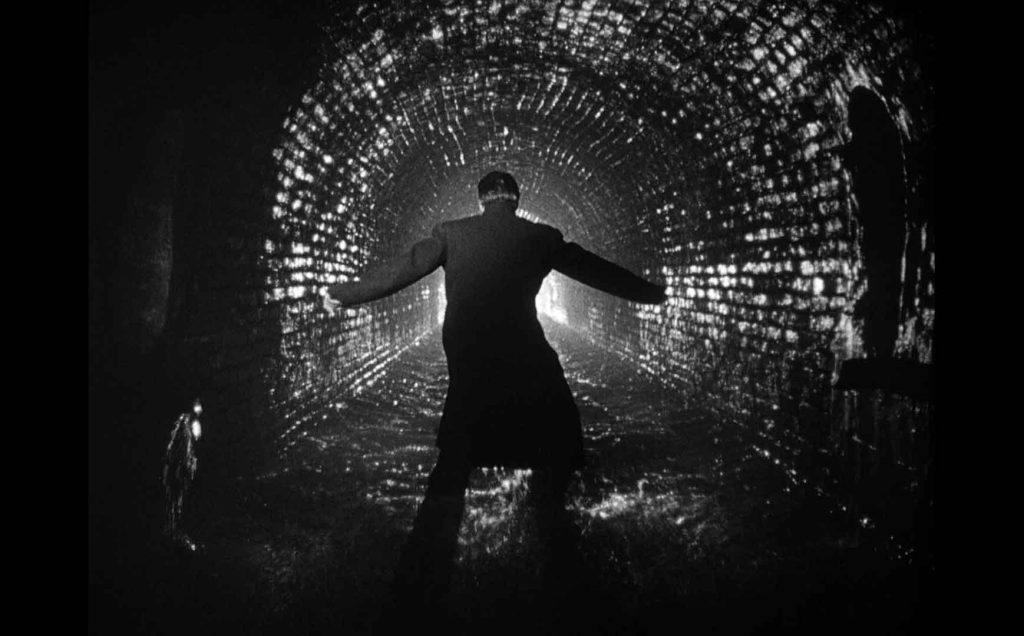
Its clearest connection, however, is Robert Krasker’s astonishing black and white cinematography. Other films have shown us this city, and these streets, in this era, but it’s so lovingly and strikingly photographed here that certain images have simply become iconography: long shadows in front of harsh backlights, overwhelming pools of inky darkness, shafts of light peering out from behind the postwar rubble, reflected on the wet cobblestone streets, and those tunnels, my god, those tunnels. They’re where we go for the climax, a stunning orchestration of shadow and sound (without score, zither or other) that would be a perfect ending for just about any movie. But this one gives us one more scene that tops it. Some days, when I think of The Third Man, I think of that tunnel chase, or Harry Lime’s reveal, or the cuckoo clock speech. But most of the time, I think of the melancholy and longing of that final composition, the leaves slowly falling, the music sadly vamping, and the beautiful, unknowable woman, who passes Holly Martins by, and doesn’t so much as break her stride.
“The Third Man” begins engagements, with new 35mm prints, at New York City’s Film Forum and Los Angeles’s New Beverly Cinema today. It is also streaming on Kanopy, Amazon Prime Video, and several ad-supported streamers.