Craig J. Clark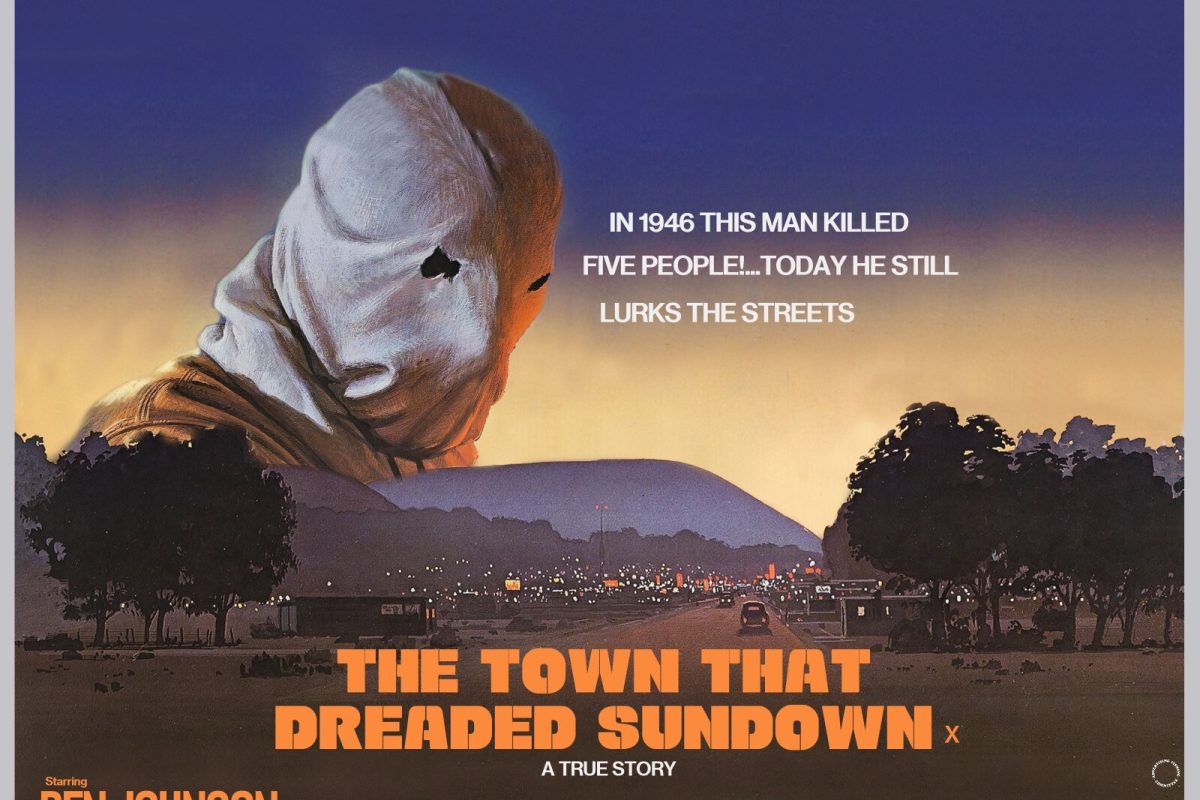
“Texarkana looked normal during the daylight hours, but everyone dreaded sundown.”
Long before the rise of found footage, a subset of horror films used the notion of a basis in “real events” as a hook to lure viewers in and paper over some of the more outlandish turns they take. One prominent example is Tobe Hooper’s The Texas Chain Saw Massacre, which opens with sober narration and even pins down the day when it supposedly occurred. While it’s true Hooper and co-writer Kim Henkel were inspired by the exploits of Ed Gein – as were the makers of the same year’s Deranged, which retained the Wisconsin setting – no one is expected to take at face value the idea that they’re depicting “one of the most bizarre crimes in the annals of American history.”
A film that lands more squarely on the side of believability is Charles B. Pierce’s The Town That Dreaded Sundown. Like Chain Saw, it employs a narrator to establish the setting and identify the major players. “The incredible story you are about to see is true,” he says authoritatively. “When it happened, and how it happened. Only the names have been changed.” When it happened was the spring of 1946, when a psychopath dubbed the Phantom Killer baffled police and turned Texarkana, Arkansas, into the title locale. As for how it happened, while screenwriter Earl E. Smith gets the dates of the Phantom’s attacks right, he and Pierce fudge some of the facts. Even so, the reality that the Phantom’s violent assaults and murders were actually committed is never in doubt, which makes them all the more chilling when Pierce shows them.
The Town That Dreaded Sundown was Pierce’s fifth feature in five years, no small feat for a regional, independent filmmaker, but his first was 1972’s The Legend of Boggy Creek, a bona fide hit on the drive-in circuit that, like The Town, was marketed as “A True Story.” (It even includes a line of narration – “Fouke is a right pleasant place to live… until the sun goes down” – that found its echo four years later.) The huge return on its modest investment immediately made full-time directing an option, and Pierce had no shortage of colorful stories he wanted to tell.
By the time Pierce set about making The Town in 1976, he had a crime drama about ’30s bootleggers and two westerns under his belt, so recreating postwar Texarkana wasn’t that great a leap. (He certainly had access to all the vintage cars he could want.) He also had a solid repertory company to draw from, and the means to hire the likes of Ben Johnson (five years out from winning the Oscar), Andrew Prine, and Dawn Wells for marquee value. The real star of the show, however, is the hooded fellow hovering over the Texarkana skyline on the iconic poster.
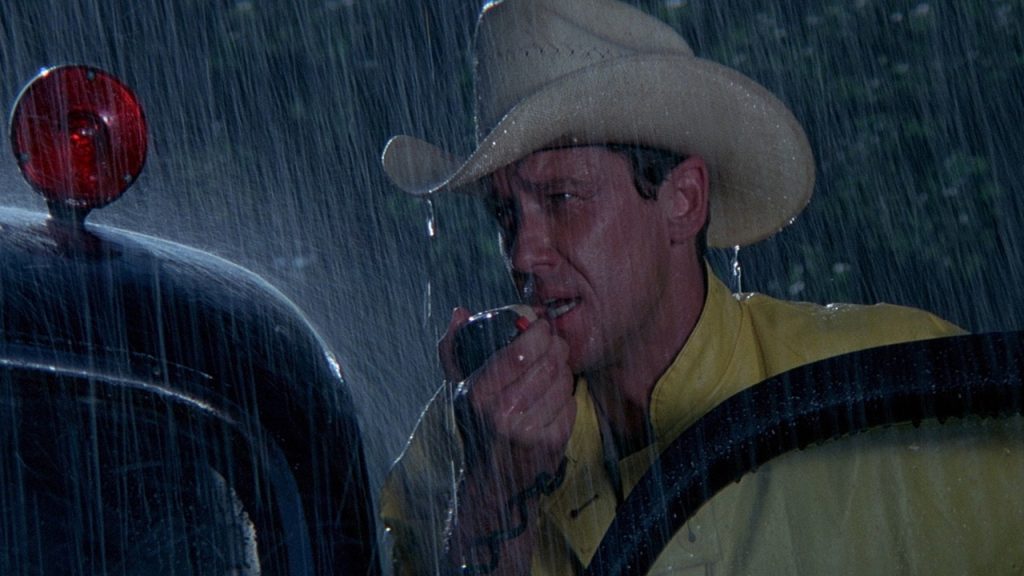
Pierce signals that the Phantom will be active whenever he flashes the date on the screen. (His first attack was on March 3; his last, exactly two months later.) He also draws attention to the Phantom’s footwear, which is distinctive enough to be immediately recognizable when it shows up in other contexts. Clad in a denim jacket, black leather gloves, and a white sack hood (making him the obvious model for Jason Voorhees in Friday the 13th Part 2), the Phantom cuts an intimidating figure, an impression amplified by the fact that he never speaks, though his heavy breathing is occasionally heard on the soundtrack. Instead, he grimly goes about his business, bludgeoning or shooting unwary young men and biting or stabbing the young women who pick the wrong night to park with them. (The Phantom definitely stakes out lovers’ lanes, and even works on a regular schedule the authorities try in vain to use to anticipate his moves.)
As unnerving as the scenes with the Phantom are – even the one where he improvises a weapon using his victim’s trombone – they’re undercut to no small degree by the incongruous comic relief Pierce and Smith throw in. (Pierce’s character, a rookie patrolman with the nickname “Sparkplug,” is the chief offender, but there are others.) They also have to overcome the fact that the Phantom case was never solved, so their story has no obvious conclusion, though Andrew Prine takes credit for inventing the eleventh-hour pursuit during which his character and Ben Johnson’s Texas Ranger nearly catch the fiend, with Johnson winging him in the leg.
In a way, this lack of resolution makes The Town That Dreaded Sundown the Zodiac of its day, and it even prefigures the open ending of Halloween, which came along two years later. The difference there, of course, is John Carpenter didn’t show Michael Myers attending the hometown premiere of his film, as Pierce does by lingering on the shoes of someone waiting in line outside the theater – someone who walks with a slight limp.
“The Town That Dreaded Sundown” is streaming all sorts of places where people prefer not to go out at night.