Kimber Myers
Even if you don’t know what kind of movie you’re watching with Atonement, it’s clear that the opening scene of familial peace and joy won’t last. This kind of moment exists in movies only to be interrupted by tragedy, especially in ones based on a true story like this drama. After a title card delivers two definitions of the word “atonement”—”1. satisfaction or reparation for a wrong or injury 2. the exemplifying of human oneness with God”—the audience is told that it’s Iraq in 2003, further hinting at what’s to come.
Three generations of the Khachaturian family are together under one roof after attacks around Baghdad have made areas unsafe. But then their current house begins to feel more dangerous, and they quickly pack up and head toward another home, when they’re caught in the midst of fighting between American soldiers and Saddam Hussein’s fighters. What unfolds from there is shocking yet not surprising, as the family of civilians is affected by the violence amidst the chaos and confusion of the war surrounding them. The inciting incident is just a few minutes of time, but its ramifications linger for the Iraqi family, the U.S. soldiers, and an American journalist covering the war for years to come.
For his debut feature after earning an Oscar nomination for his live-action short “DeKalb Elementary,” writer-director Reed Van Dyk structures the bulk of his film into three sections a decade later. One follows Lou D’Alessandro (Boyd Holbrook), a marine whose unit fired on the family’s cars without knowing who was inside back in 2003. He has finally finished his multiple tours, but what he and his peers did that day haunts him as he struggles to string together a life in the U.S. The second section follows Michael Reid (Kenneth Branagh), who was writing for The New York Times in 2003 and is now covering other Middle Eastern conflicts for The New Yorker and for his own book. Yet while he has moved on to other jobs, his time spent in Iraq stays with him, and he has kept in contact with the Khachaturian family after sharing their powerful story with the world. Seeking atonement for his actions, Lou learns the survivors now live just a few hours away from him in California, and he asks Michael to arrange a meeting. The third section centers the experience of matriarch Mariam Khachaturian (Hiam Abbass) on the day Lou and Michael arrive at her home where she lives with her daughter (Gheed), son-in-law (Majd Eid), and grandchildren.
Atonement is clear about the impact of an event like this, whether you’re the victim, the perpetrator, or the witness. Van Dyk’s approach treats each person as a human deserving of empathy, and it does a good job of not centering the American soldier’s perspective, which still feels depressingly radical. The film—and various characters—questions Lou’s motives for wanting forgiveness and what meeting him might mean for the Khachaturian family. Is his peace worth what the experience might dredge up for Mariam and her daughter? With its varying perspectives, Atonement is an intensely thoughtful, humanist drama that is somehow even more emotionally resonant than one might expect.
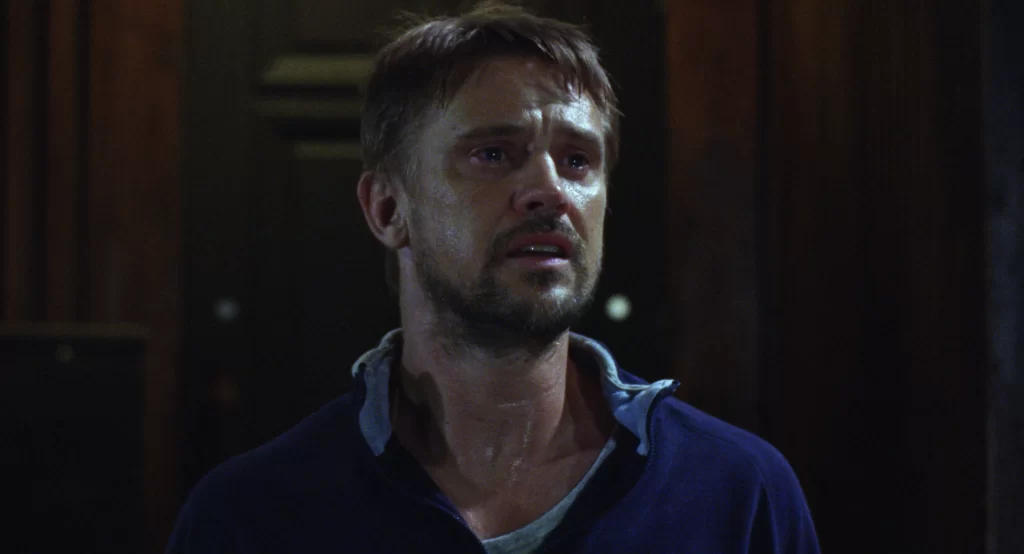
There is real emotional power in this story, and much of the credit goes to the trio of actors at its heart. I haven’t seen Holbrook working in this register before. He’s most recognizable as the bad guy in films like Logan and Indiana Jones and the Dial of Destiny, but Atonement largely focuses on a man who is broken by what he did and doesn’t categorize him as the villain. Holbrook plays Lou with intensity, but it never feels like too much. Branagh uses a solid American accent to play the journalist caught up in the worst day of the surrounding characters’ lives, and his rumpled writer questions the ethics of what’s happening without ever seeming too didactic. Abbass is heartbreaking, from the grief she feels in the moment of the tragedy to the hardened woman she has become a decade later who still finds herself capable of hospitality and grace with her guest. Each character is portrayed with subtlety and endowed with humanity.
Van Dyk’s film doesn’t always feel cohesive or propulsive, but it remains held together by these people and their story. By starting his film with a dictionary definition, he’s more obvious than his actors with what he’s trying to do, but this is still an impressive debut. He manages to stick the landing, leaving the audience with a powerful final shot that ensures that Atonement’s theme of how people search for forgiveness and meaning will stay with them.
B
“Atonement” is in theaters Friday.