Zach Vasquez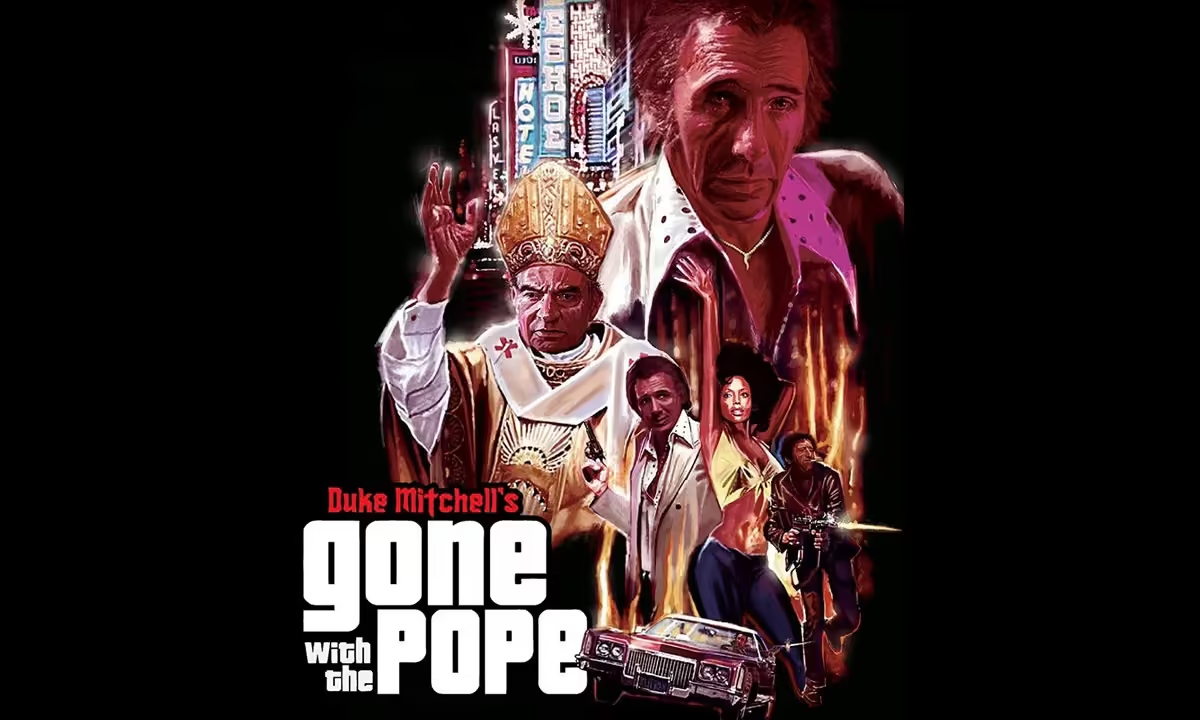
I’ve seen a lot of exploitation movies with a lot of exploitation movie audiences. For as vociferous as they can be when served their beloved sex, violence, and sleaze, they generally know what to expect, so it’s hard for a film to legitimately shock them. It’s even harder for one to upset them. I can think of only a single film that brooked out-and-out, audible discomfort from such a crowd. That movie was Gone with the Pope.
Long thought unsalvageable, Gone with the Pope was the passion project of Duke Mitchell, a lounge lizard crooner, comedian, actor, and self-proclaimed “King of Palm Springs.” Mitchell never experienced mainstream fame, although he rubbed elbows with it in the 1950s, befriending and sometimes performing alongside the likes of Lenny Bruce, Liza Minnelli, and Frank Sinatra.
On the big screen, Mitchell appeared in one Rat Pack-adjacent project, popping up briefly (and uncredited) in the Dean Martin/Jerry Lewis comedy Sailor Beware (1952). His own attempt to ape that act’s success by taking on the Martin role in a musical comedy duo alongside Lewis imitator Sammy Petrillo was short-lived, although it did produce his first starring role in the forgotten comedy Bela Lugosi Meets a Brooklyn Gorilla (also 1952).
Mitchell only acted in two more pictures in the ‘50s (Crime in the Streets, 1956; Baby Face Nelson, 1957) and one in the ‘60s (Paradise Alley, 1964; not to be confused with Sylvester Stallone’s 1978 film of the same name, although a connection between Stallone and Mitchell will emerge later on). Then in the‘70s, inspired by the renegade spirit of New Hollywood, he took a page from the John Cassavetes playbook and decided to self-finance his own movies, starting with 1974’s Massacre Mafia Style (aka The Executioner), which he wrote, directed, produced, and starred in.
On its face, Massacre is a cheap The Godfather knock-off, albeit one that ramps up the violence so much that it distinguishes itself through sheer carnage. But it also displays a real voice. Granted, it’s a voice belonging to an insane person with zero self-awareness (Massacre fiercely condemns the stereotyping of Italian Americans in The Godfather even as it triples down on them), but it’s a voice nonetheless.
Massacre also displays Mitchell’s knack for directing. Yes, his sets are cheap, his actors are amateurs, the lighting is low and grainy, and everything has that stilted quality shared by all low-budget exploitation pictures. Still, he’s constantly finding surprising ways to shoot things. Nowhere is this more apparent than the bonkers, bravura opening, which sees two dark-suited hitmen (one of who is played by Mitchell, natch) casually stroll through an office building murdering everyone they encounter. The wild mix of juvenile hijinks—two victims are killed via urinal—with the white-knuckle terror of its climax, the ironic deployment of pop music (one of Mitchell’s own tiki-flavored exotica numbers), and the hard-edged, stylish swagger immediately cement this as one of the most memorable crime movies of its day. Or at least it would have, had anyone seen it at the time. Massacre wouldn’t start gaining cult status until it appeared on VHS in the ‘80s.
One person who definitely saw it during that time was Quentin Tarantino (the similarities between Massacre’s opening and Pulp Fiction are so apparent it’s not even worth debating). It was at Tarantino’s Los Angeles theater The New Beverly, circa 2013, where I first saw the film, playing on a double bill with Mitchell’s sophomore effort (for which he once again took on all major duties), Gone with the Pope.
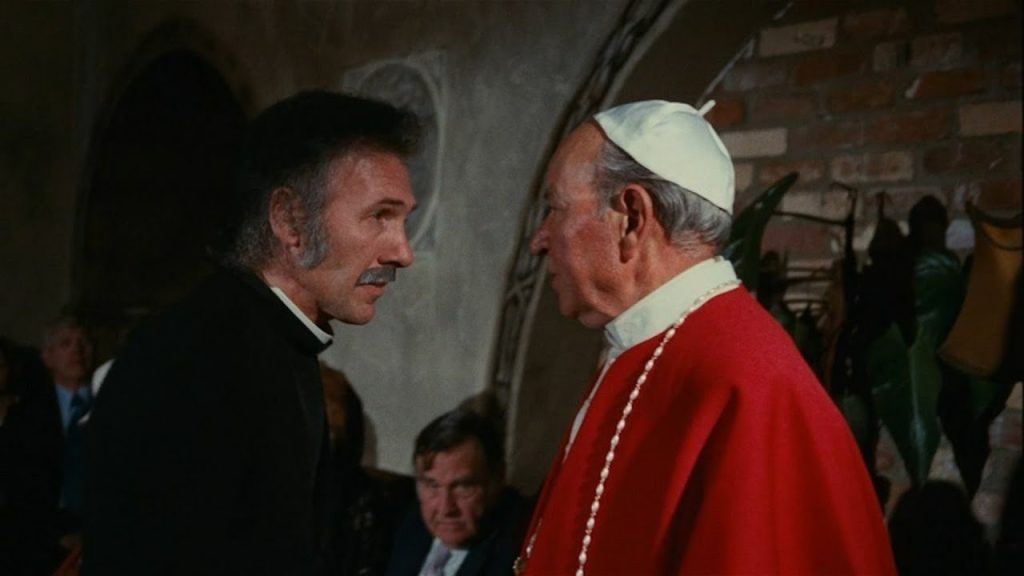
Years prior, I had seen the trailer (extremely NSFW) for Gone with the Pope at a double feature of Nekromantik 2 (1991) and Singapore Sling (1990) put on by some truly deranged underground film collective at my college. As, let’s say, memorable as both of those works are, it was the snippets of Pope that left the biggest impression on me. I immediately set about trying to track it down, only to learn that Mitchell shot the film around 1975-6, but died of lung cancer in 1981 before he could assemble a cut. Still, the fact that someone had taken the time to create a trailer gave me hope that some version of it would one day see the light.
Sure enough, that day came in 2010, thanks to the Herculean efforts of legendary film editor Bob Murawski and the late Sage Stallone (eldest son of Sly). Working with Mitchell’s son Jefferey (who also provided the film’s music, including the original track “Jacknife”, which I promise you is the hardest rock song you’ve never heard), they were able to rescue much of the footage and put together a feature-length film, hewing as close to Mitchell’s original vision as they could with what they had.
Even in its Frankenstein-like form, Gone with the Pope astounds. The premise alone is enough to make lovers of weird cinema plotz: Fresh out the can, ex-mob hitman Paul (Mitchell) recruits his three prison buddies (named Peter, Luke, and John) to help him kidnap the Pope. His ransom demand? “I want a dollar from every Catholic in the world.”
But that bonkers premise doesn’t even hint at how mad the movie actually is. Part gritty, uber-violent crime saga (impressively shot on location in Los Angeles, Palm Springs, Las Vegas, and Rome), part sincere religious confessional, and part scatological comedy, the result is a surreal mind-melter that could only have come from someone with an ego as big as the Almighty’s. If that seems like hyperbole, consider Pope’s title sequence, where Mitchell recites the first 25 verses of Genesis, before adding in one of his: “And on the seventh day, God fucked the whole thing up.”
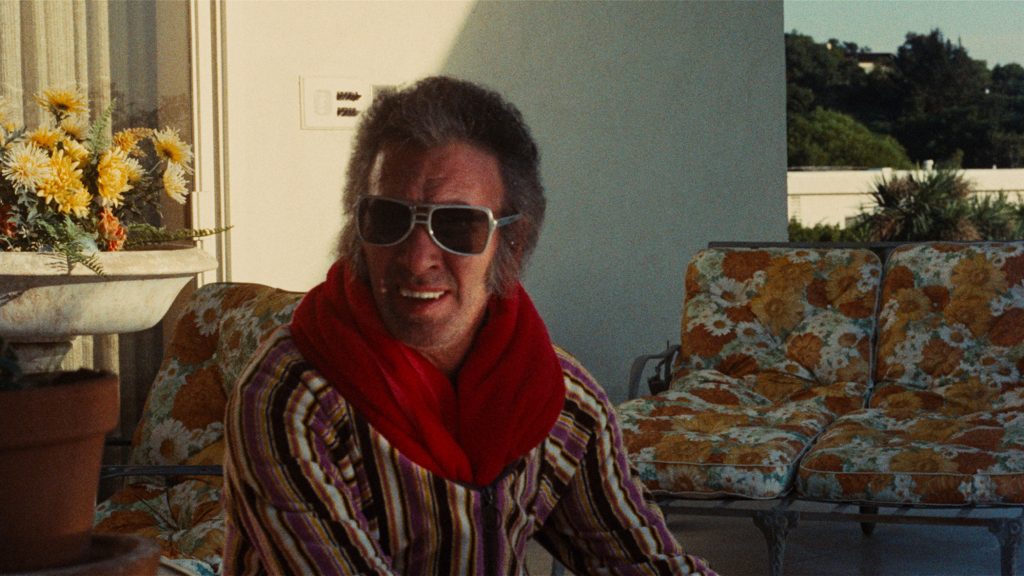
As befitting any number of cult leaders or movie directors (see current-day outsider auteur and Mitchell doppelganger Neil Breen) with messiah complexes, Mitchell cuts an utterly bizarre figure as lead actor, draping his desert lizard’s rough hide, irradiated skin, and sickly frame in outlandish Liberace-like disco glamour. And that hair! My god, that hair, like some unholy combination of pompador, Jheri curl, and mullet. I swear you can see it moving on its own at several points in the film.
His performance is just as out there—sometimes he plays things cool to the point of self-parody (of course, he makes his character a stone-cold badass, criminal mastermind, and suave lady’s man), other times he’s completely flying off the handle, screaming out in streams of profane rage so intense he seems intent on strangling himself with his own words. One can’t help but think of the scene from Curb Your Enthusiasm where Larry David (who also bears something of a resemblance to Mitchell) flails about as an apoplectic gangster in a Scorsese picture.
In the film’s most jaw-dropping scene (outside of the ending, which I won’t even begin to give away), Paul berates the purloined Pope for the sins of the Catholic Church, particularly their abandonment of European Jews during the Holocaust. It’s a staggering bit of clear-eyed, righteous fury, made all the more unexpected when contrasted against the racial politics of the rest of the film. For both Mafia Massacre Style and Gone with the Pope are, inarguably, deeply racist films.
The number of epithets aimed at the films’ Black characters—including some I’ve never come across anywhere else—is simply staggering. It’s easy to compartmentalize this in Massacre, because at least there they are being hurled by hardened criminals. The racism in Pope feels much more personal, especially during a deeply grotesque and seemingly never-ending dialog between Paul and a Black prostitute he hires seemingly only to insult. This is the scene I mentioned up top. It’s so out of pocket it got even the hardened New Bev crowd to mutter their disapproval.
(It should be noted that Mitchell’s misogyny crosses racial bounds, as seen in the second most indefensible moment of the movie, a Benny Hill-like ‘comedic’ orgy between Paul, his cronies, and an obese woman he picks up in the park. The scene is made even rougher by the way it keeps threatening to tip over into full-on pornography.)
Mitchell, both the man and the artist, was clearly very fucked up. But it’s that same fucked up-edness that allowed him to create two of the most unforgettable exploitation pictures of all time, one of which may just be the strangest movie ever made. Profound, profane, ridiculous, hideous, and utterly original, rarely has a masterpiece so thoroughly reflected its creator as Gone with the Pope.
God fucked it all up, indeed.
“Massacre Mafia Style” and “Gone with the Pope” are available on a variety of ad-supported streamers. “The Duke Mitchell Collection” is available to purchasefrom Grindhouse Releasing on August 25th.