Craig J. Clark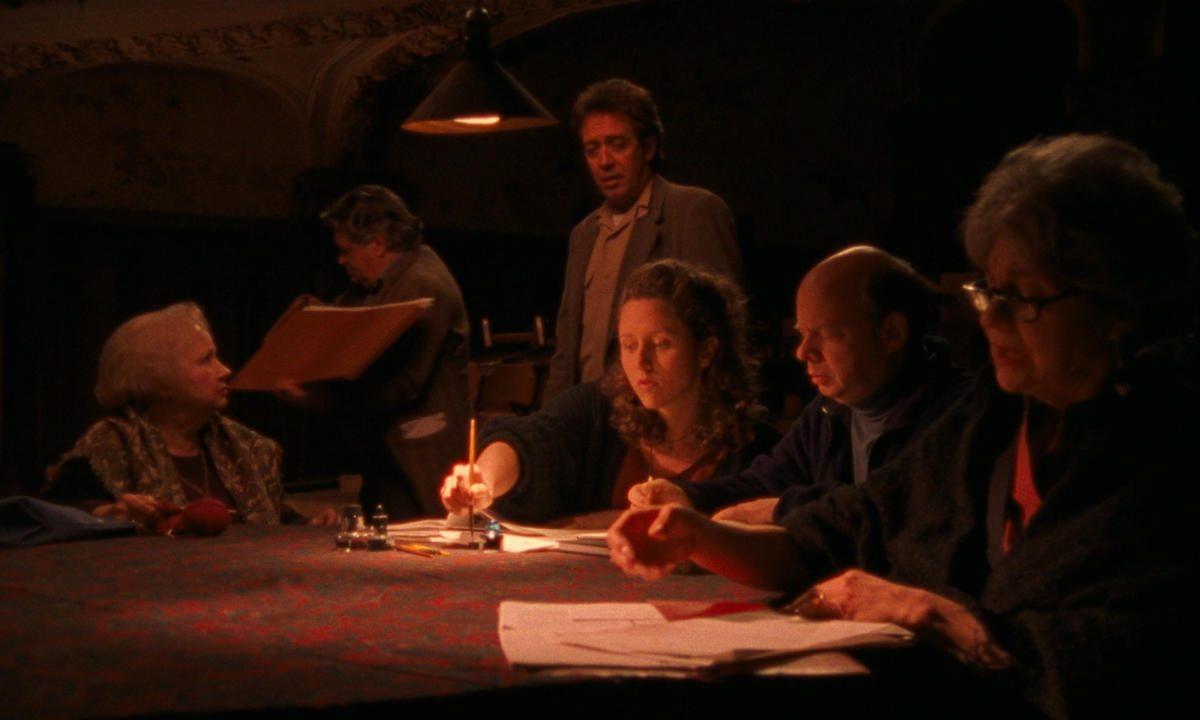
There are certain films that, if encountered at the exact right moment, can have a profound effect on someone’s life. For me, one such film is 1994’s Vanya on 42nd Street, which was directed by Louis Malle and reunited him with Wallace Shawn and Andre Gregory, the stars of his arthouse hit My Dinner with Andre. I saw it not on its theatrical release, but seven years later, on cable. I don’t remember the exact dates I’ve seen most films, but Vanya is an exception: I watched it the afternoon of September 11, 2001.
How I came to be home in the middle of a workday isn’t terribly mysterious. Once it was clear what had happened that fateful Tuesday morning in New York City and Washington, D.C., everyone at my office was sent home for the rest of the day. At loose ends, as many people were, I flipped on the TV, as many people did, but decided watching the endlessly cycling reports on cable news would not be in my best interest. Luckily, I noticed Vanya on 42nd Street was just about to start on Bravo, so, remembering Roger Ebert’s glowing review (he gave it three and a half stars), I opted for that instead.
Right from the start, it looked like a transmission from a different era. Documentary-like shots of 42nd Street give the viewer glimpses of how it was in the pre-Giuliani era. In some, members of the acting ensemble can be spotted walking amongst the crowds of pedestrians or, like Shawn, thoughtfully noshing on a knish on the sidewalk. They all converge on an abandoned theater – the New Amsterdam, which was subsequently renovated, but at the time of filming the stage was unusable. The crumbling interior served as the perfect backdrop for Gregory and his actors, some of whom bring guests to be the audience for that day’s rehearsal, which is to be a rare run-through of the entire play.
Using David Mamet’s adaptation of Anton Chekhov’s play as their text, the actors remain in their street clothes and use their regular speaking voices. Props are basic and no attempt is made to evoke the period when it was written, which lends the play an immediacy to match Mamet’s modernized dialogue. (At one point, Shawn even drinks out of an “I ♥ NY” cup.) As guided by Gregory over the years of rehearsals (they started in 1989 with no intention of ever mounting a full production), the actors don’t treat Uncle Vanya like a museum piece, and the casual way they slip into the play after five minutes of milling about and kibitzing is subtle enough first-time viewers may have no idea the performance has started until one of them mentions vodka.
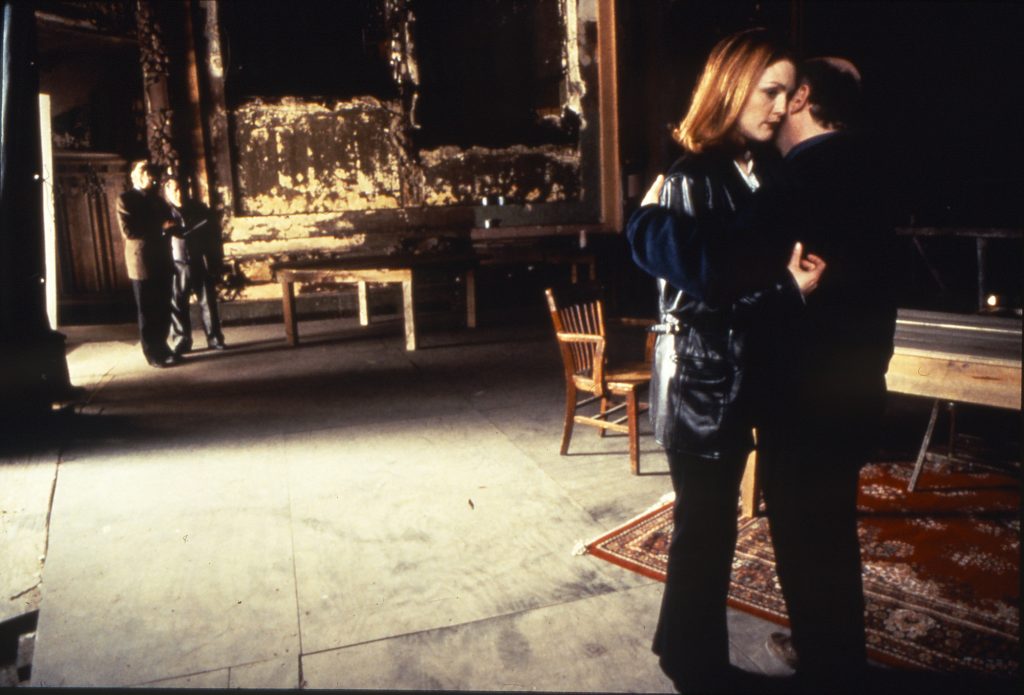
The impressive cast Gregory assembled is naturally headed by Shawn as Vanya, who has grown into a bitter, middle-aged crank after managing his family’s country estate on behalf of his former brother-in-law, a retired professor he can’t stand, for 25 years. Vanya also nakedly lusts after the professor’s much younger second wife, Yelena, given luminous life by Julianne Moore. Meanwhile, her husband, Serebryakov, is played by veteran actor George Gaynes with the kind of dignity he could rarely muster for the Police Academy series or Punky Brewster.
Another familiar face is Brooke Smith as Serebryakov’s daughter Sonya, who manages the estate with Vanya (and with a lot less grumbling) while nursing a crush on the doctor who visits frequently to treat her father’s various ailments. This is Dr. Astrov (Larry Pine), who talks of being a conservationist concerned about how they’ll be viewed by future generations, but he’s just as besotted with Yelena as Vanya is – and much bolder about how he pursues her. With so many characters at cross purposes, is it any wonder none of them are truly happy with their lot in life?
The brilliance of Malle’s approach to adapting Gregory’s production reveals itself in the subtle ways he incorporates cinematic techniques that don’t impinge upon the actors’ performances. While scene changes are accomplished by the audience getting up and moving to a different part of the theater, with Gregory filling them in on where they are, the play’s monologues are often shot in long takes, and Malle breaks with convention by having Moore deliver one of Yelena’s in voiceover. After it’s all over, he even gives every member of the ensemble a close-up, the film equivalent of a curtain call. Since Vanya turned out to be Malle’s final feature, he could have given himself one as well.
Since I first saw Vanya on 42nd Street, I’ve often thought about how it captured for all time a city that no longer exists. That Tuesday afternoon, 25 years ago, I had a choice between two alternate Big Apples: one where the Twin Towers had just been destroyed, and one where a group of like-minded artists could come together to create something magical. I believe I chose wisely.
“Vanya on 42nd Street” is available on Blu-ray from the Criterion Collection. It is also part of the collector’s set “Andre Gregory & Wallace Shawn: 3 Films.”