Craig D. Lindsey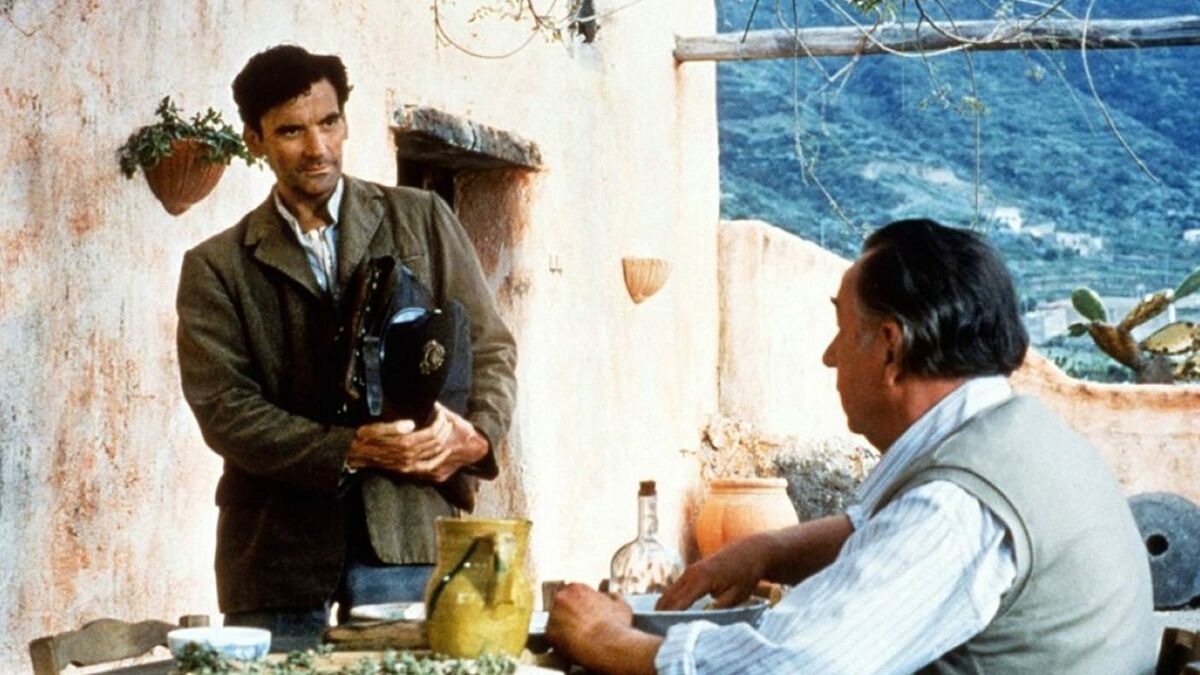
Welcome to Harvey’s Hellhole, a monthly column devoted to spotlighting the movies that were poorly marketed, mishandled, reshaped, neglected or just straight-up destroyed by Harvey Weinstein during his reign as one of the most powerful studio chiefs in Hollywood. The Academy Awards are upon us, so let’s take it back to another point in Oscar history when Weinstein was banking on an Italian import to win him some gold.
Thirty years ago, the Academy Awards came under fire being – dare I say it – too dull and boring in its nominations.
Then-Republican presidential candidate Bob Dole went after Hollywood for peddling sex, violence, and other immoral entertainment he didn’t get around to actually watching. After giving Quentin Tarantino’s hip scuzzfest Pulp Fiction seven nominations (including Best Picture) the year before, the Association for Motion Picture Arts & Sciences – AMPAS, to all the ladies in the world – opted to award the best films and performances of 1995 in a safe, inoffensive, and blatantly racist manner.
Despite being produced by Quincy Jones and hosted by Whoopi Goldberg, the 68th annual Oscars were definitely so white. Of the 166 nominees, only one was Black. (People dropped a cover story calling it “The Hollywood Blackout.”) The Best Picture nominees were just as pale-faced: We had movies about White people in space (Apollo 13), 13th-century Scotland (Braveheart), 19th-century England (Sense and Sensibility), and some Anglo countryside where animals talk (Babe). As Rolling Stone critic Peter Travers said in his yearly this-is-why-the-Oscars-blows takedown, they were “nonthreatening movies set in the past, stoked with sentiment and, save for a few gory battle scenes in Braveheart, suitable for later family viewing on television without need of a V-chip.”
There was one more Best Picture nomination that at least had an olive-colored cast. Coming from Italy, Il Postino (aka The Postman – not to be confused with that 1997 epic flop directed by and starring Kevin Costner) was a charming romantic dramedy that Harvey Weinstein was hellbent on turning into a hit.
Weinstein said he cried up a storm when he saw it at the ‘94 Toronto International Film Festival, straight-up swooning over the story of Mario (Neopolitan actor/comedian/filmmaker Massimo Troisi), a dopey but sensitive Italian guy who becomes the solo postal carrier of his small fishing island. He mainly delivers to real-life Chilean poet Pablo Neruda (Philippe Noiret), who’s living in exile with a boo thang (Anna Bonaiuto) who can’t keep her hands off him. With Mario usually handing over fan letters from Neruda’s predominantly female fanbase, our lonely mailman seeks Neruda’s help in saying the right things to women, especially when he falls for a ravishing local waitress (Maria Grazia Cucinotta, who shockingly claimed Weinstein never harassed her) who’s a sucker for romantic metaphors.
Troisi (dubbed “the Steve Martin of Italy” by fans) bought the film rights to Chilean author Antonio Skármeta’s 1985 novel Ardiente Paciencia (translation: Burning Patience), which Skármeta made into a movie two years earlier. Troisi wrote a treatment and sent it to British director Michael Radford; he was a fan of Radford’s 1983 WWII book adaptation Another Time, Another Place. Along with several screenwriters (including Troisi’s ex-girlfriend Anna Pavignano), Troisi and Radford fleshed out a script that omits the original movie and book’s 1970s Chile setting and drops it in 1950s Italy. (Neruda was exiled in Italy in the early ‘50s where he wrote his Nobel Prize-winning book of poetry Los versos del capitán, or The Captain’s Verses.)
Ailing from a heart condition brought on by childhood rheumatism, Troisi was so weak he could only work for an hour a day, with his stand-in handling most of the workload. When he completed his final scene, he died 12 hours later, at the too-damn-young age of 41. Along with a dedication at the end, Troisi received a co-directing credit with Radford (but that’s only in the Italian version).

Weinstein went all out in making Postino a summer sleeper, even throwing some merchandise out there. Through the Miramax Books wing, Skarmeta’s novel was re-released in paperback under the film’s name, along with a companion collection of Neruda poems titled Love: Ten Poems. For the soundtrack album, he had A-list celebs reciting Neruda poems over Luis Enríquez Bacalov’s fisarmonica-heavy score. Julia Roberts, Samuel L. Jackson, Glenn Close, Ethan Hawke, Sting, and Madonna are just a few of the stars Harvey somehow cajoled into taking part.
Postino is precious but uneven, often teetering between swarthy, sweltering romance, breezy buddy comedy, and politically-charged melodrama. Radford shoots a bulk of the movie with handheld cameras, giving off a fidgety energy (this is most likely Radford putting us in the anxious, lovesick headspace of Mario, who says he gets dizzy from Neruda’s amorous words) that gave me a headache.
Despite how I feel about it, Postino was received favorably from critics and audiences around these parts. With a domestic gross of over $21 million, it became one of the top 15 highest-grossing international films in North America, surpassing the Spanish-language love story Like Water for Chocolate (also from Miramax). This also meant Weinstein was on the hunt for another Best Foreign Language Film Oscar, just like the one Miramax received for Cinema Paradiso – another charmer from that boot country – several years before. But even though it was shot in Italy, with an Italian cast and crew, produced by Italian film company Ceechi Gori, it was deemed ineligible because it was directed by a Brit.
This didn’t stop ol’ Harvey from launching a full-on Oscar campaign for other categories, including Best Picture. On the first weekend of that new year, Miramax expanded Postino to 250 screens – 70 screens more than when the studio went wide with Chocolate. For the revamped ad campaign – complete with the title in a zestier font – they went for full transparency, stating their Oscar goals and calling out the Academy for the Best Foreign Film business. I can just imagine Weinstein giggling his ass off at the reopening-day newspaper ad, thinking, “You bitches brought this on yourself!”
The brutal-honesty angle worked. Postino was nominated for five Academy Awards, including Best Picture and a well-deserved, posthumous Best Actor nom for Troisi. But it only won one statuette on Oscar night, for Bacalov’s score (also well-deserved). When all the hoopla died down, Best Director nominee Radford signed a three-picture deal with Weinstein. (He claimed he was strapped for cash and going through a divorce.) But, after his hellish experience directing the doomed Asia Argento vehicle B. Monkey, stepping in after original director Michael Caton-Jones departed, he somehow escaped Weinstein’s greasy-ass clutches. “I’ll never work with them again, and you can quote me on that,” Radford said in 2008, before clarifying, “Not Miramax, but Harvey Weinstein.”
While the other Best Picture nominees of 1996 have become beloved, contemporary classics (even though its star/director is a racist lunatic, you gotta admit Best Picture winner Braveheart still slaps), Postino has become another integral title Miramax has virtually scrubbed from its history. It’s not currently streaming anywhere, and it’s yet to have a proper Blu-ray release in this country. I’m quite certain that whoever’s reading this either forgot about that flick or didn’t know it existed. I’m also quite certain Radford’s messy exit from the company had something to do with it.
It’s common knowledge that Weinstein is a petty muhfucka, and burying films from filmmakers who’ve pissed him off is kinda his thing. Besides, Postino served its purpose as another Oscar-winning success story for Weinstein. I’m sure the man who literally died bringing it to the screen is somewhere very happy – not for his movie, but for the living hell Weinstein (the man who exploited, then discarded, his dream project) is going through as our nation’s second most infamous scumbag sex offender who’s knocking on death’s door.
Thankfully, the Italian subtitled version of “Il Postino (The Postman)” is on YouTube– for now.